Karine Tawil on Architectural Femininity, Rome and the Future of Karoline Lang
For Fall/Winter 2026, Karoline Lang heads to Rome, where sculpted silhouettes, dramatic proportions and flashes of green stand against the city's Rationalist architecture. JDEED speaks to founder and designer Karine Tawil about the women who shaped her aesthetic, the importance of a perfect fit and her plans to take the label into couture.
Karine Tawil has always paid attention to how women dress. Growing up surrounded by elegant women, she developed an early appreciation for the way clothing could change someone's posture, attitude and sense of self. Her mother, an architect, introduced another fascination: the relationship between form, proportion and construction.
Both influences would eventually find their way into Karoline Lang, the fashion house she founded nearly sixteen years ago. “I grew up surrounded by very elegant women. From an early age, I felt comfortable with dressing, carrying myself and expressing who I was through clothes,” Tawil tells JDEED. “With an architect mother, I also developed a sensitivity to form, proportion and construction.”
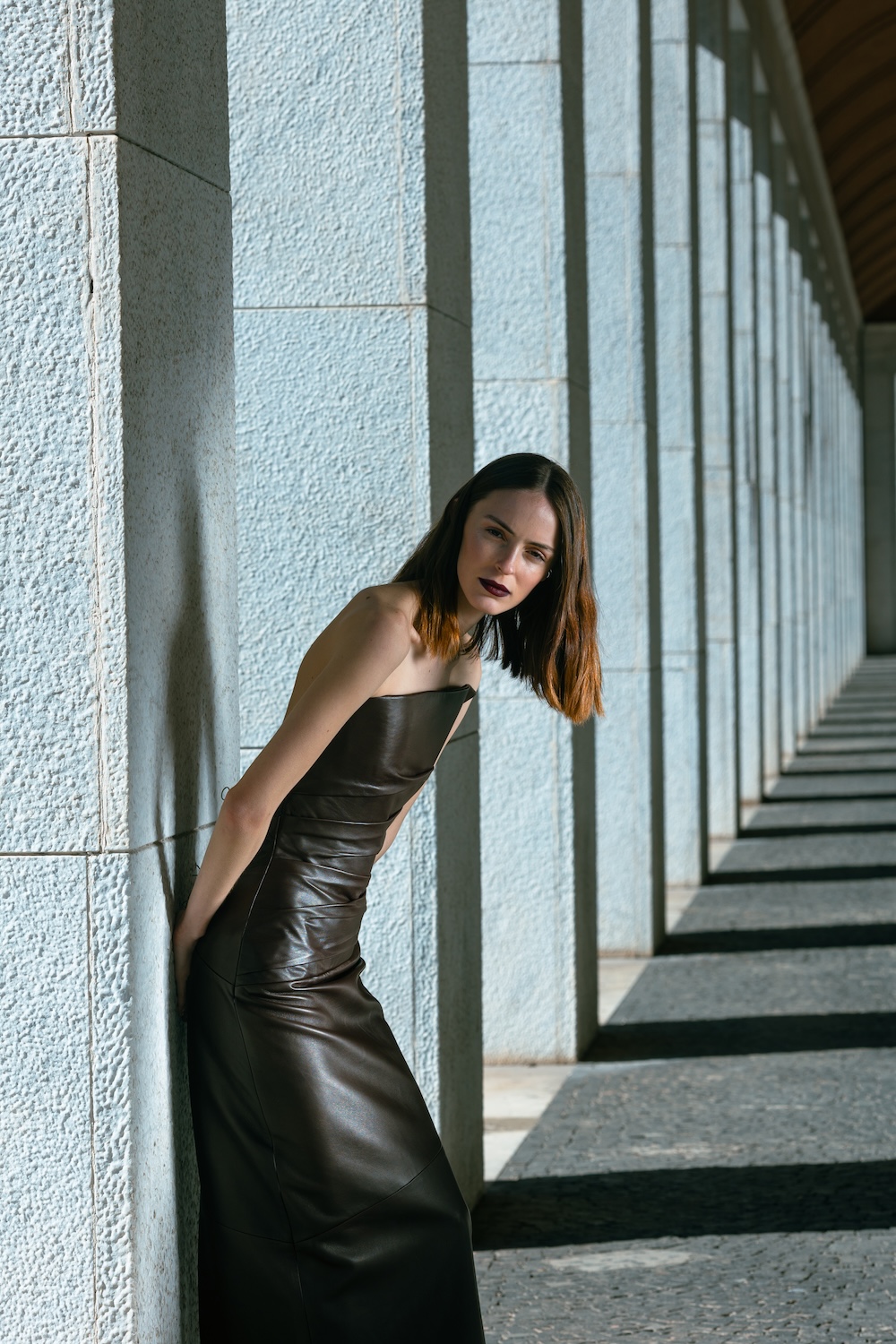
That architectural influence is immediately apparent in the label's Fall/Winter 2026 collection. Shoulders are sharply defined, waists carefully sculpted and fabrics manipulated into silhouettes that appear structured without restricting the body. The accompanying campaign, photographed by Gianmarco Camoagna, takes place in Rome's EUR district, with its monumental columns, repetitive arches and imposing stone façades.
It's a rather different Rome from the one we're accustomed to seeing in fashion campaigns. There are no romantic cobbled streets or familiar postcard views. Instead, Tawil has chosen the city's Rationalist architecture, particularly the geometric severity of the Colosseo Quadrato, as the backdrop for her designs.
The choice is personal. “Italy has a very personal place in my life. I studied and lived there, and it shaped my appreciation for proportion, craftsmanship and the beauty of everyday life. Rome carries an additional emotional significance because it is where I got married.”
The EUR district, conceived in the 1930s for a planned 1942 Universal Exhibition, appealed to her precisely because it reveals a less familiar side of the Italian capital.
“What interested me was precisely that it offers a less expected vision of Rome. There is a striking beauty in its scale and restraint that people may not immediately associate with the city.”
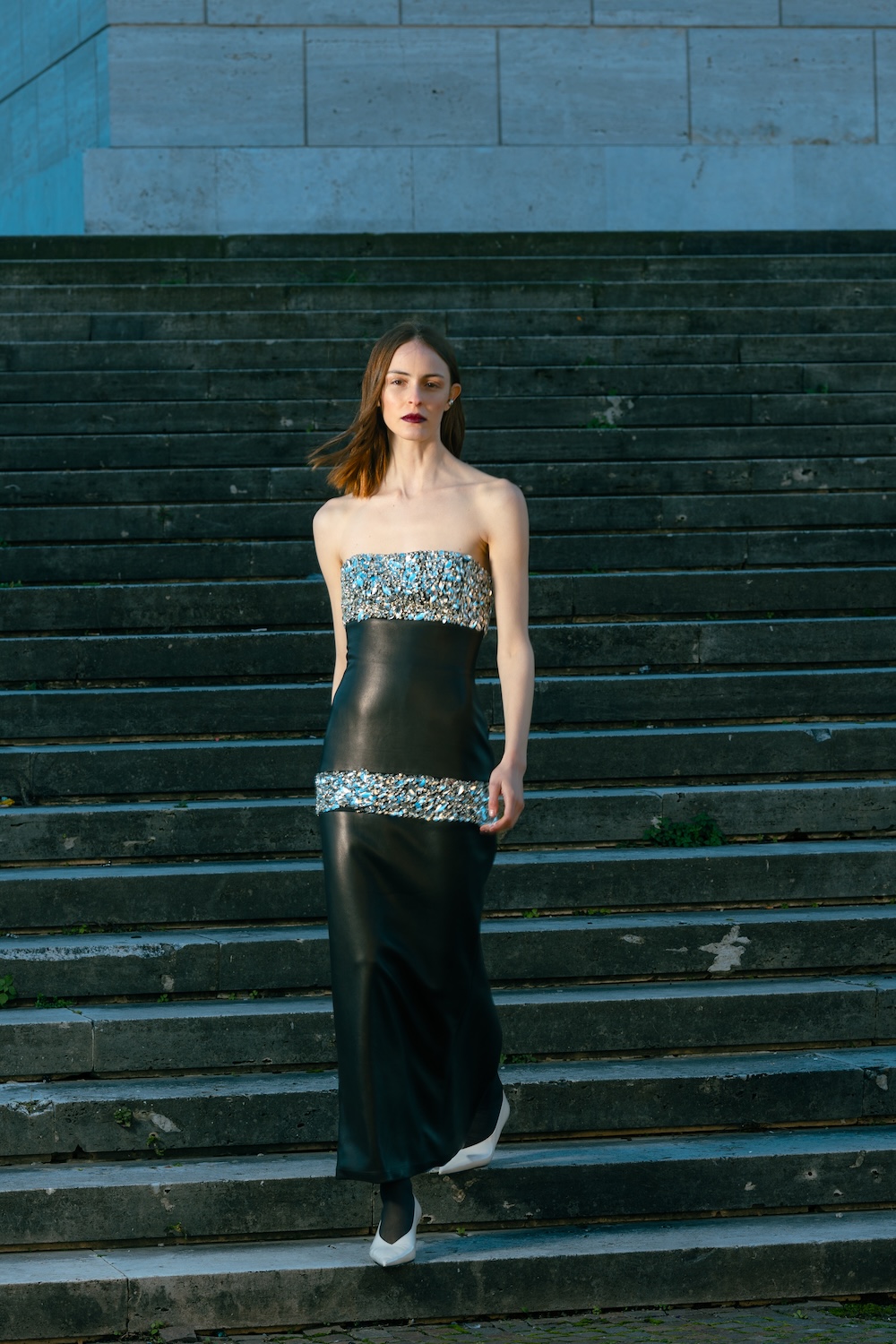
In the campaign images, the relationship between the clothing and its surroundings is striking. A sculptural black dress opens into dramatic panels of turquoise and black, while a vivid green coat catches the wind against the pale stone. Elsewhere, fitted evening dresses, asymmetric necklines and fluid tailoring introduce movement into the rigid architectural setting.
“What interests me most today is the human hand and how far we can take our craft,”
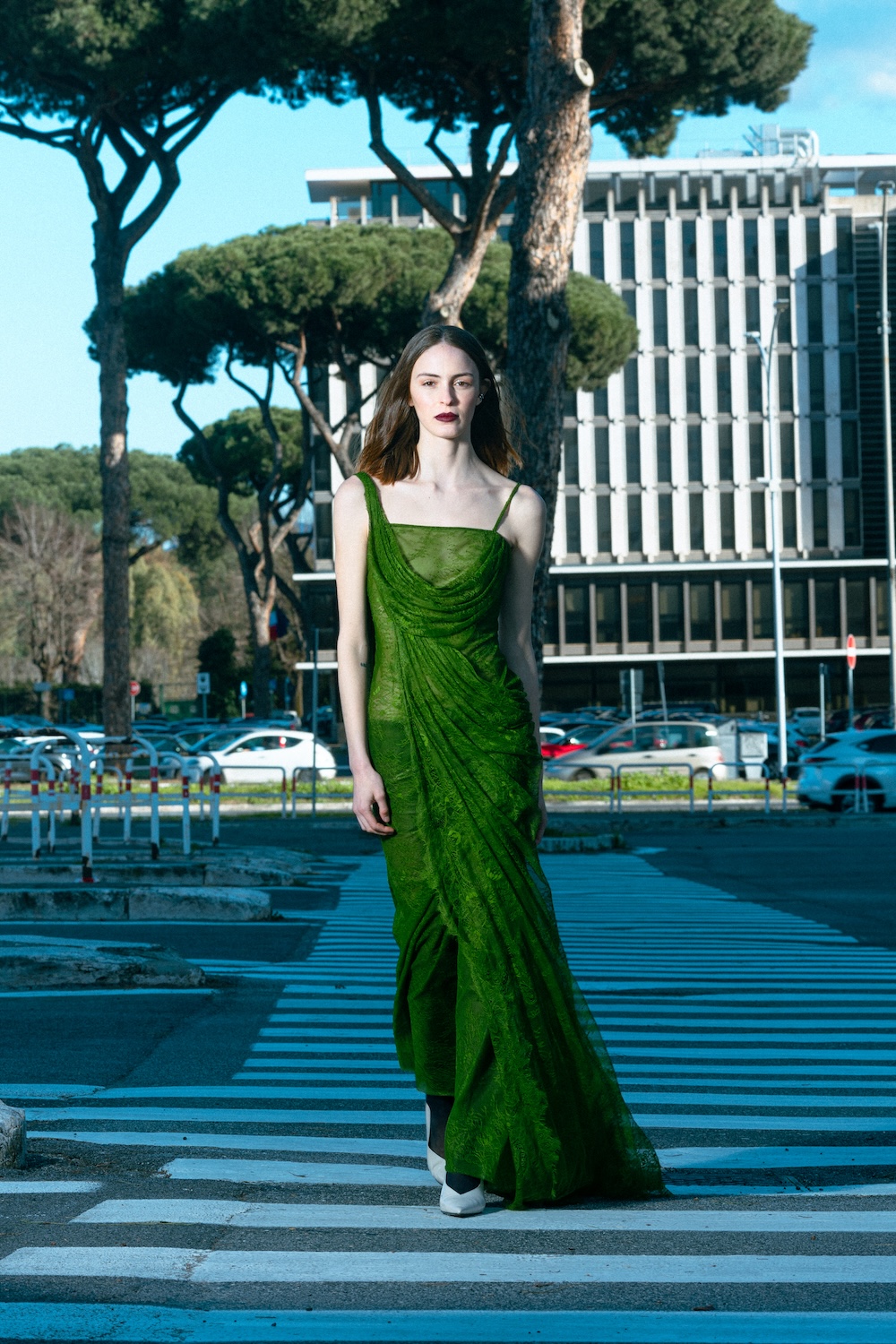
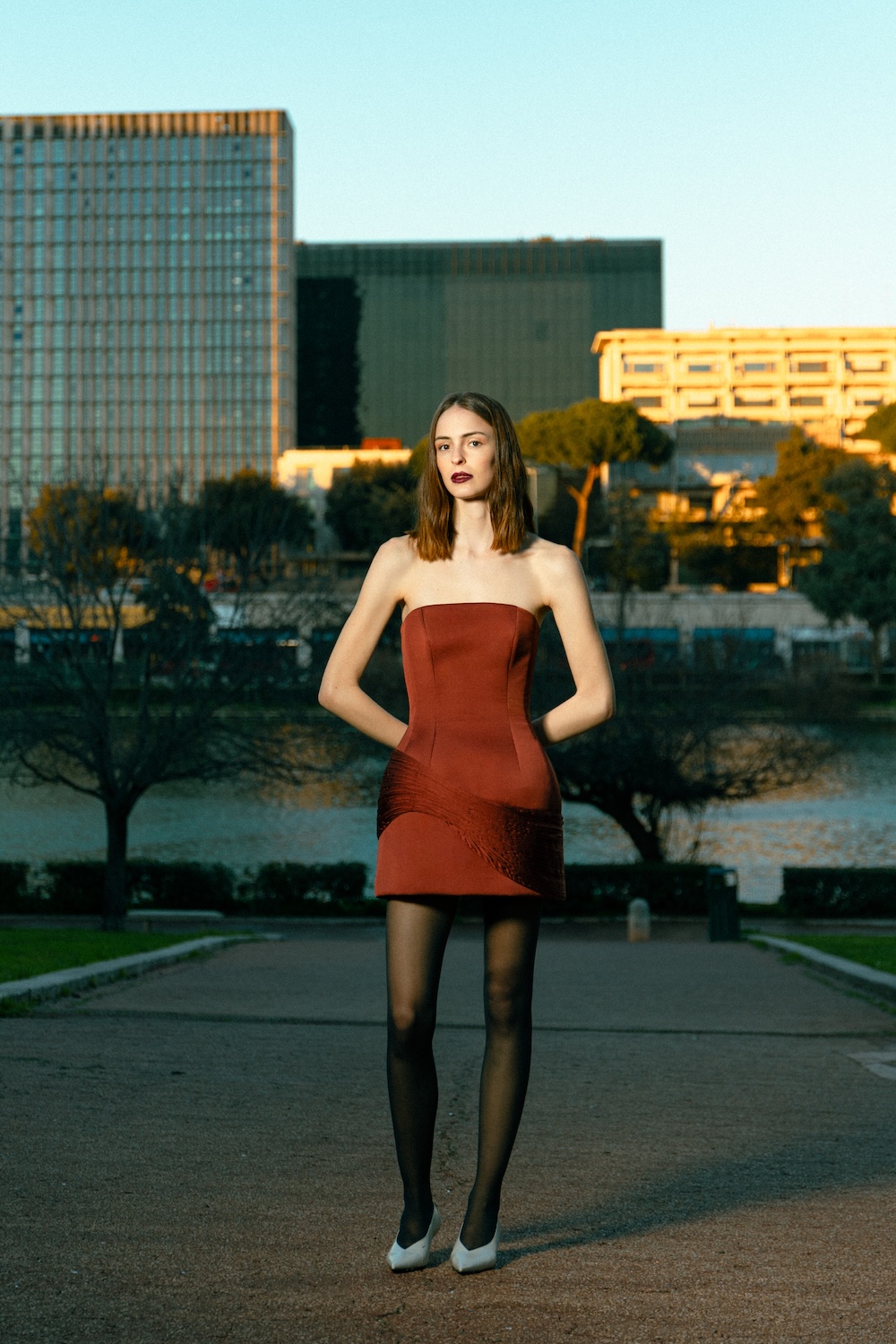
“The elongated silhouettes, defined shoulders and sculpted shapes find an echo in the architecture, while draping and fluid fabrics bring movement to its stillness,” Tawil explains. “I loved the presence of a woman within those vast spaces, and the way the collection’s green came alive against the pale stone.”
For the designer, the collection is an extension of an approach she describes as architectural femininity. It's a term that makes sense when looking at her clothes, but Tawil is quick to point out that their construction is only part of the story: “I would describe the identity of Karoline Lang through architectural femininity: precise construction, a sensitivity to the body and a balance between strength and delicacy. A defined shoulder, a sculpted waist or an unexpected drape can give a piece its character.”
What matters just as much is what happens when someone actually puts the clothes on.
“The intention behind my clothes is fully understood when they are worn. I design them to sculpt the body, creating a sense of support and the feeling of a second skin that gives a woman strength and confidence.” Much of that work happens away from the campaign shoots, inside the atelier, where fittings can involve repeated adjustments to seams, proportions and the way a garment sits against the body.
“Our clients know this: trying on a piece reveals something that an image alone cannot convey. It is about what it does for their silhouette, how it feels against the body and how they move in it.”
It's a detail worth remembering in an industry where so much of fashion is consumed through photographs. Tawil's clothes are designed to be experienced physically, with the wearer playing an essential role in completing the silhouette. Her interpretation of femininity follows a similar logic. Rather than prescribing a particular attitude or aesthetic, she is interested in allowing women to move between different expressions of themselves.
“Modern femininity, to me, is the freedom to express different aspects of yourself. A woman can feel strong, delicate, sensual or restrained, and move naturally between those qualities.”
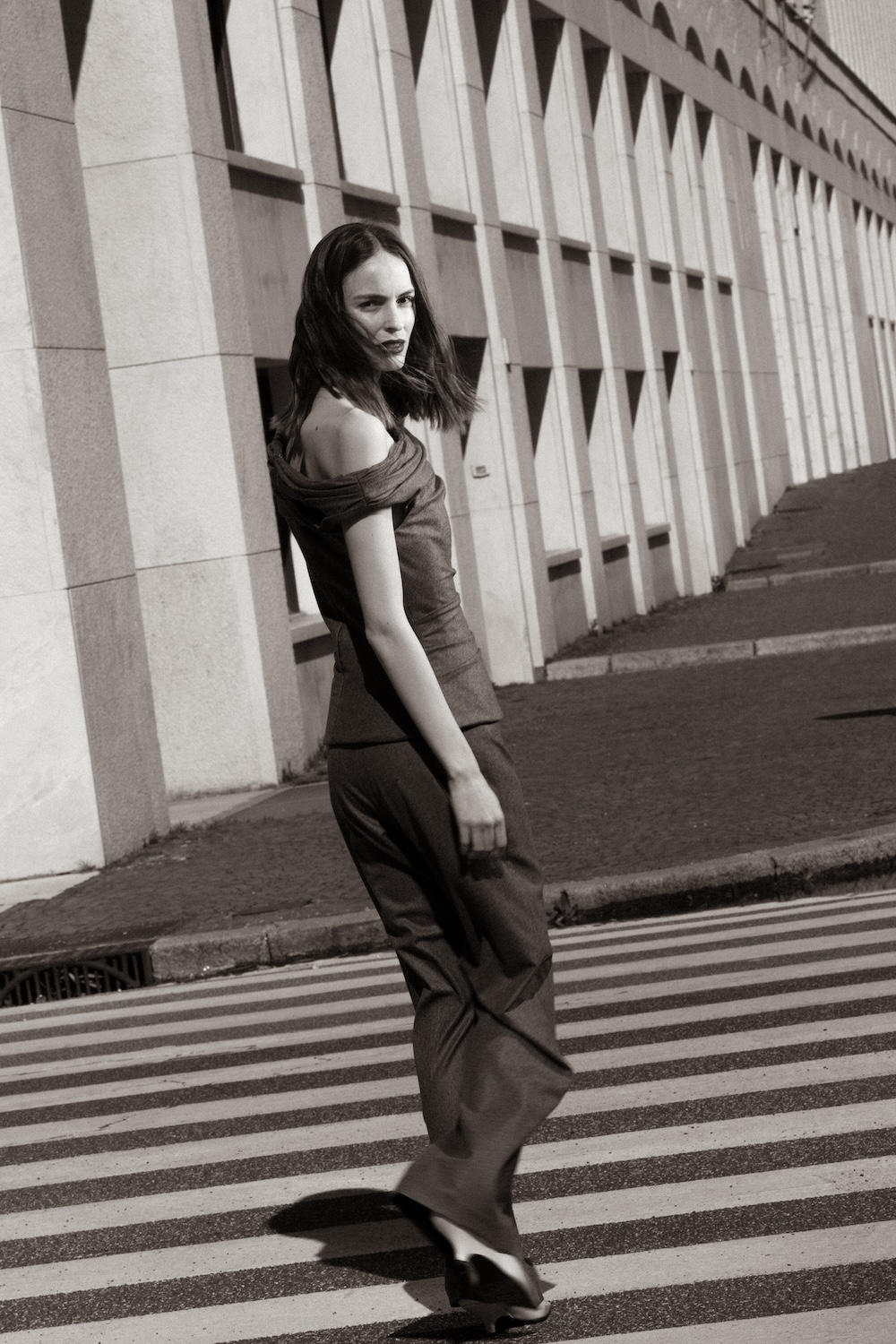
Finding that freedom within highly constructed garments is, she admits, one of the more demanding parts of her work: “I want her to feel the strength of the construction while remaining completely at ease in her movement. Finding that balance is the most challenging part of my work.”
After almost sixteen years of developing the label's signature cuts and construction techniques, Tawil is now looking at what comes next. And she's particularly interested in pushing the technical abilities of her atelier. “What interests me most today is the human hand and how far we can take our craft,” she says. “We have reached a level of expertise that makes me want to push those skills further, and we are investing in the time, experimentation and handwork this requires.”
One of her next ambitions is to introduce a couture capsule collection, allowing her team to spend more time exploring complex shapes, materials and techniques.
“Creating a couture capsule collection is a natural next step. It will give me the freedom to develop ideas that need more time and exploration, and to discover new possibilities in shape, texture and technique alongside the atelier.”
Accessories are also on her agenda, particularly belts and jewellery, which she sees as opportunities to experiment with sculptural forms on a smaller scale.
For Tawil, these developments are part of a gradual evolution rather than a dramatic reinvention. Her understanding of clothing has become more precise over the years, but the fascination that began with the women around her and her mother's architectural eye remains. “I have learned where to place structure, where to allow softness and how much a single line can express,” she reflects.
Looking at the Fall/Winter 2026 collection, particularly those sharply cut silhouettes against the vast architecture of Rome, it's easy to see what she means. Sometimes the smallest adjustment to a line makes all the difference.
Karoline Lang Fall/Winter 2026. Photography by Gianmarco Camoagna. Videography by Umberto Luigi De Angelis. More on Karolinelang.com
More news


