Erdem at 20: We Sat Down With The Designer And Curator Olivier Gabet To Discuss "About Time, About Her"

As ERDEM marks two decades, Qatar Museums has opened the first exhibition dedicated to Erdem Moralioglu's creative journey. The designer and curator Olivier Gabet talk about choices, collaborators and the white bride where it all began.
Walk into the first room of ERDEM: About Time, About Her and you are met by a white bride: the very first piece from Erdem Moralioglu's very first collection. Walk into the last and you are surrounded by his Autumn/Winter 2026 collection, the show that marked the label's 20th anniversary.
For the designer, seeing the two side by side was unexpectedly moving. "When you walk into that white space, I had a little lump in my throat," he says. "As a designer, you don't usually see it all together."
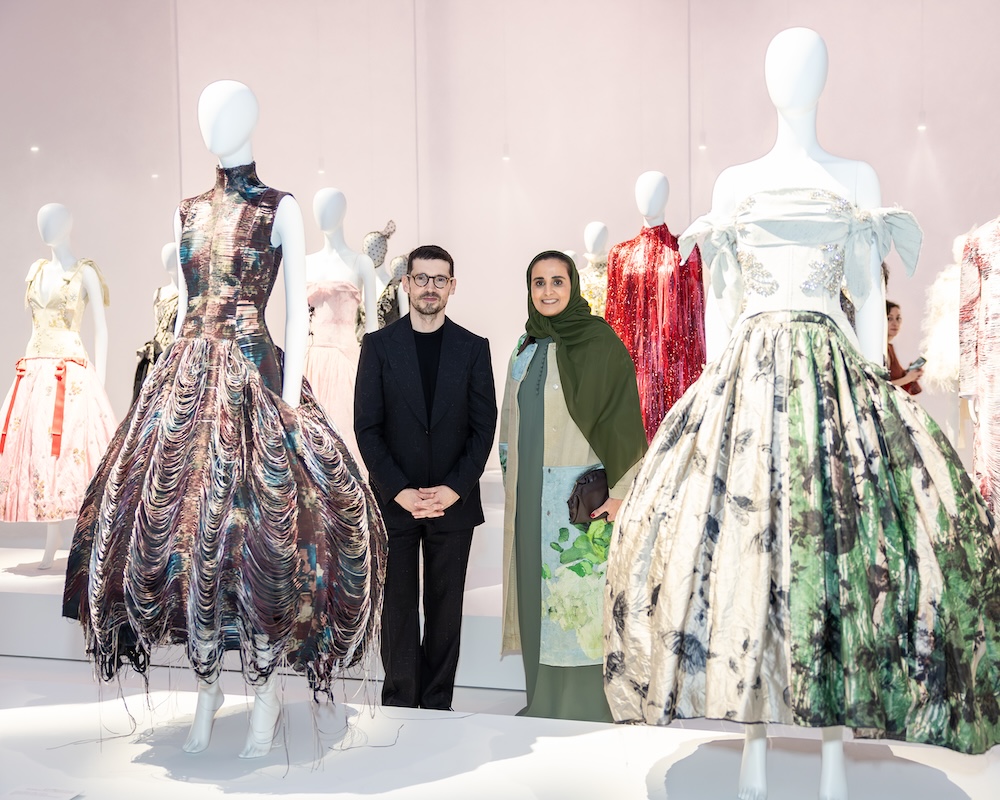
Presented by Qatar Museums at M7 in Msheireb Downtown Doha until 26 December 2026, the exhibition is the first dedicated to Erdem's creative journey. More than 150 pieces (garments, sketches, personal ephemera and atelier materials) are arranged across five thematic chapters and placed alongside paintings, sculptures and decorative arts from the Museum of Islamic Art. It is curated by Olivier Gabet, Directeur du Département des Objets d'Art at the Musée du Louvre, with exhibition design by P. Joseph and immersive installation design by Robin Brown, and forms part of the Qatar, Canada and Mexico 2026 Year of Culture.
"I have always been fascinated by the capacity of clothing to hold the trace of a person, a place or a moment in time," Erdem said when the show was announced. "Bringing together a 20-year body of work, this exhibition reflects the lives, narratives and encounters that have shaped an evolving language."
By Cynthia Jreige
"Not a traditional fashion exhibition"
The build in Doha took almost two months, but the idea goes back much further. Erdem describes the exhibition as "a conversation that was ongoing over several years" with Her Excellency Sheikha Al Mayassa bint Hamad bin Khalifa Al Thani, Chairperson of Qatar Museums. Much of the curating happened in London. "We built the vitrines in London and laid everything out," he says. "Olivier spent a lot of time coming to London, which was easy from Paris."
From the outset, the aim was something other than a parade of dresses. "Really from the get-go, as Olivier mentioned, we were collectively determined that it wouldn't necessarily be a traditional fashion exhibition," Erdem says.
Designer and curator already had history. Gabet had shown an ERDEM dress in his acclaimed Louvre Couture exhibition in 2025, which Erdem visited in Paris with Her Excellency. "It was so inspiring, such a sideways, out-of-the-box way of approaching fashion and objects," he recalls. "So right away, Olivier's very disruptive way of showing fashion was something that was so exciting."
Opening the archive to someone else turned out to be revealing. "You're discussing your work with someone who knows your work," Erdem says. Because a designer is "so attached to it," he explains, "it was interesting for him to make those connections that you wouldn't necessarily make yourself. It's almost like a psychiatrist pointing out something that's there."
Twenty years of ERDEM means thousands of looks, and only a fraction could make it into M7. For Gabet, editing a living designer's work is no different from editing an artist's. "It's always complex to make choices, whether you are the designer or the artist — I make no difference," he says. "There is always a moment where you say 'not this, not that,' which doesn't necessarily mean it's less good or better; it's more about where it's relevant, where it can take place, or where it's interesting to have these echoes."

The process was easier than he expected. "We had a lot of time, and I didn't see the time pass, because there was a willingness all around the Erdem team that made it happen in the most beautiful way," he says. "Everything was very smooth — a very natural process."
Gabet is clear that the era of the curator-as-auteur is over. "I don't believe anymore in the all-powerful curator who arrives, makes a statement, and everybody has to follow. No," he says. "A curator in this kind of exhibition is there to be part of a process, a very maieutic process: to draw out what's important for you, what you want to demonstrate in this exhibition, what you want to share with people."
The muses were the hardest part. ERDEM collections are each built around a woman whose story has rarely been told, and the exhibition's chapter The Muse gathers figures such as the Duchess of Devonshire, Maria Callas, Margot Fonteyn, Marianne North and Hélène Smith, as well as the 1958 meeting between Queen Elizabeth II and Duke Ellington. "How many muses you have! So many," Gabet says. "So at one point you have to say, okay, which ones do we choose to make it possible in Doha — which would be the most relevant, the most expressive, the richest material."
He also wants visitors to understand what a living designer is risking. "For many people, when they talk about an exhibition on a living artist or designer, there's this idea of 'oh, it must be good, you must be happy to have an exhibition.' That's a very superficial way of looking at it," he says. "For any designer or artist, having an exhibition is a challenge. It's a risk — a risk to show your work at one point with a certain perspective, a certain choice and selection."
That is also what separates a retrospective from a catwalk. "It's a very different way to look at 20 years of work — in the same moment, in the same place, and with a lot of time," Gabet says, "because it's obviously not ten minutes of a show; you can spend hours." Working with a friend raises the stakes further: "When you are lucky and privileged enough to work with a friend who is a living designer, it's also important to feel that he is happy with the results."
In the exhibition's announcement, Gabet put it more grandly. The show, he said, "is therefore not simply a retrospective, but a portrait of an imagination in motion."

Was there ever a moment of doubt, or of pushing back against the curator? "In truth, no," Erdem says. "As I said, it was such a natural process."
Part of the reason is that the people behind the exhibition are the people behind the brand. Exhibition designer Philip Joseph, "who I met in college, has designed everything that I've ever done," Erdem says, from the early show spaces to the first store. Robin Brown, who created the exhibition's immersive spaces, took over the brand's show spaces more than a decade ago, and Lucas, whose sound design runs through the galleries, "makes all of our soundtracks."
"It was almost like putting together a runway show, because in a sense you're working with everyone you've always worked with," Erdem says. "As a designer you're constantly producing the new and the next — it's a changing world — so to have a team around you that's constant is very, very valuable. So in a sense, I would say there were no surprises."
The layout was worked out in miniature first. "We had a model in the studio that was to scale," he says. "Olivier and I spent so much time looking at this model, placing things and looking at how things went. And then to suddenly see this model in real life, and to understand how it hung together architecturally as well, was really interesting."
He insists the result isn't only for people who already know the label. "For someone who's maybe unfamiliar with my work or my world, or just broadly interested in creativity," he says, "I really think there's something for everyone."
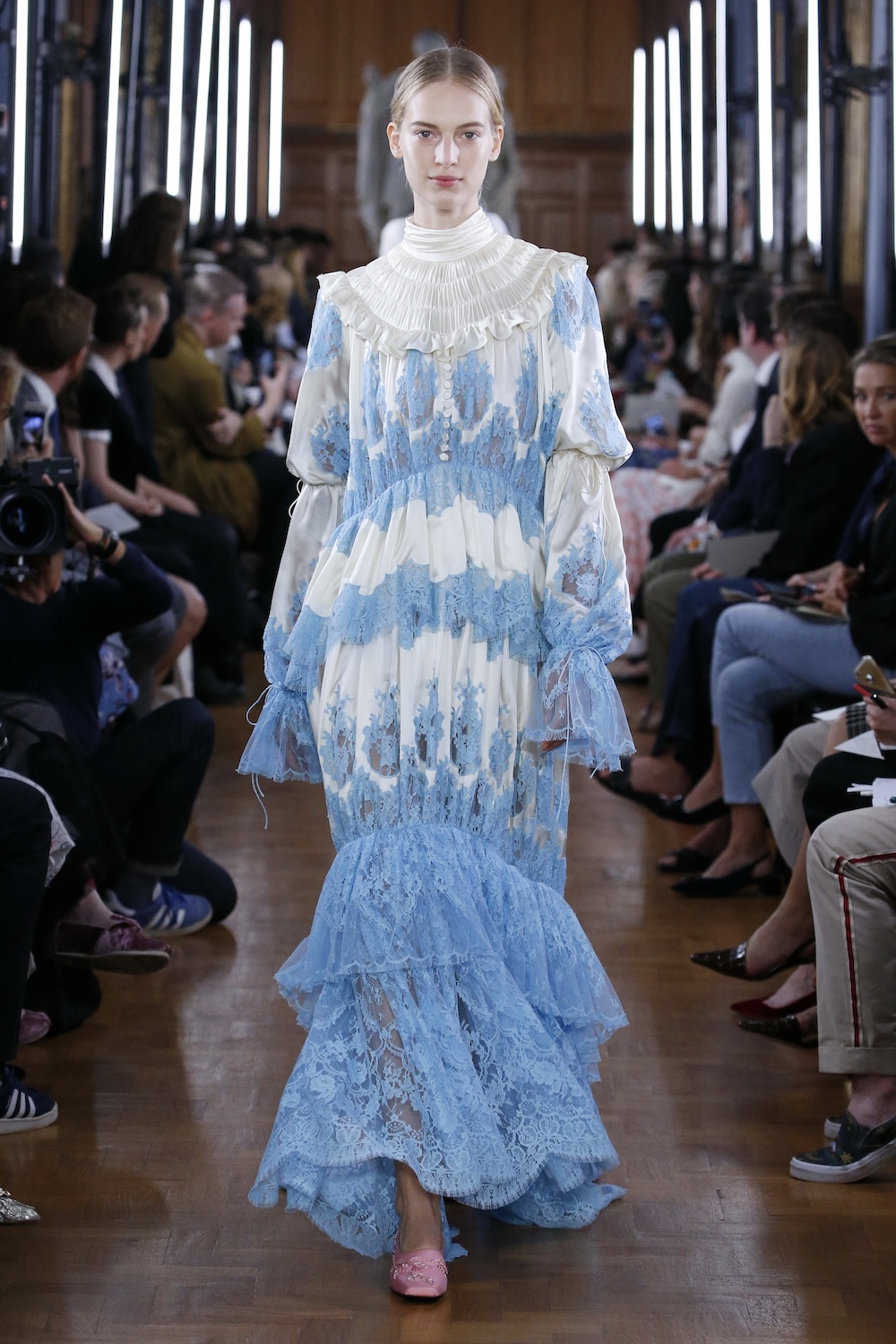
Which brings us back to the two rooms that moved him most: the first, with the white bride, and the last, The Imaginary Conversation, given over to the anniversary collection. Even in the brand's Paris showroom, he says, "you never see everything at the same time." Seeing it here "was like a summary of where we are now," he says. "It felt like then and now — and actually how close they are. It felt very interesting. And far away."
Asked what feeling has stayed with him from the start of the brand to today, he answers in one word. "Curiosity," he says. "A curiosity to explore and discover these worlds and stories. I find it so exciting to explore and discover a new life and world. And also, as a creative, it forces you to turn the page."
Gabet sees that curiosity as the key to the work. "Erdem draws upon art, literature, and history with both the rigour of a scholar and the freedom of a storyteller," he said in the announcement. "His work belongs to that rare territory where fashion becomes culture."
For M7, the show is also a lesson for the next generation. Director Maha Al Sulaiti said it "offers audiences a rare opportunity to engage closely with the thinking behind a globally recognised fashion house, while inspiring emerging designers to understand how a distinctive creative identity can be developed over time."
Erdem's own verdict on the experience was simpler. "It was honestly an honour," he says.
ERDEM: About Time, About Her is at M7, Msheireb Downtown Doha, from 27 October to 26 December 2026.