Irony as Resistance: Trashy Clothing FW26 at the Institut du Monde Arabe

Nowadays, fashion often takes itself a little too seriously. Trashy Clothing, on the other hand, thrives on irony while addressing a topic that is undeniably serious — and that tension is precisely what makes it so compelling. In an industry that often confuses solemnity with depth, a little irreverence can be surprisingly sharp.
Set in the brutalist steel building of the Institut du Monde Arabe, the show unfolded in a space that is far more than a museum. The institution has long served as a cultural haven for young creatives who prefer not to play by the rules, which feels entirely in line with the way Omar and Shukri approach their work.
By Mark Khoury

The self-described anti-luxury luxury label was founded in 2017 by Shukri Lawrence and Omar Braika, who use irony to address the state of the world through Y2K references and an avant-garde spirit. When asked whether they considered their work a form of protest, Shukri explained that it was “more of a documentation, in better lighting and from a different angle, than a protest.”
Inspired by Divine Intervention, the film by Elia Suleiman, the messaging behind the collection drew a clear contrast between the mundanity of everyday life and militarism. As the designers explained, “During occupation, going to the salon is political, going to the gym is political. Everything becomes political.”
.JPG)

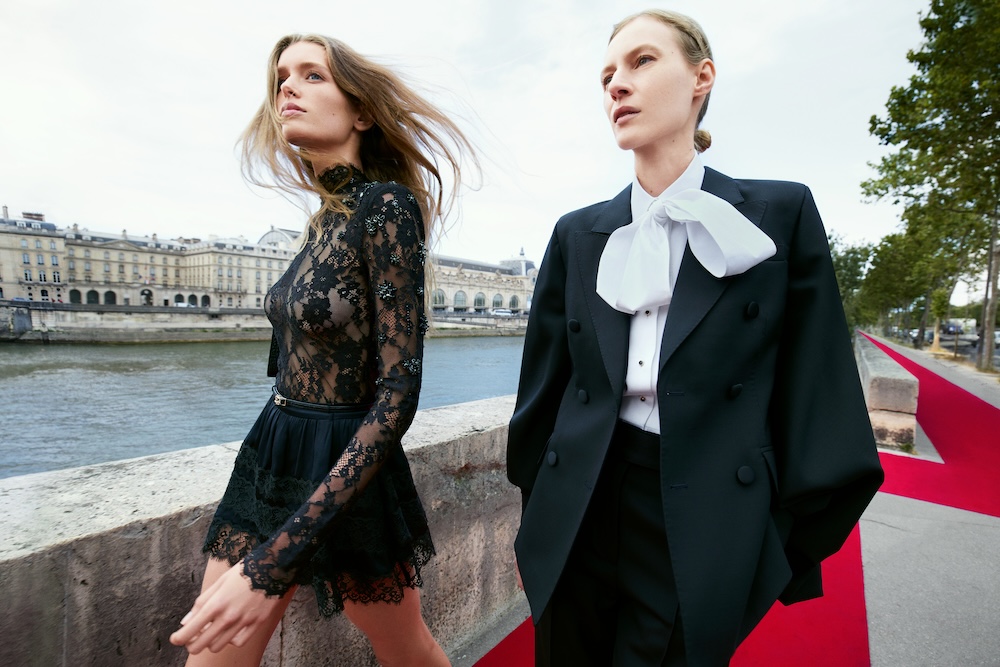
Olive green, tarboush red, sand beige, and metallic accents formed the core palette of the collection. While some silhouettes appeared boxy and avant-garde, almost presenting themselves as armor, others were strikingly figure-hugging, featuring draped delicate mesh and unconventional bras. The collection also included jewelry from Sheytan, Mia Khalifa’s brand, who was not only perfectly cast but also seemed to act as a muse for the designers themselves.


Speaking of perfect casting, Hadid sister Alana made her runway debut for Trashy, explaining that it felt “obvious for [her] to represent [her] people and walk for a Palestinian brand during Paris Fashion Week, and [she] would only do it for Trashy Clothing.”
Overall, the show was more than a coherent collection. It felt, in many ways, like a real-time documentation of life under occupation. Fashion may rarely claim such a role, but here it did not shy away from it either.
More info on TrashyClothing.shop

.png)