
When Freedom Becomes Conditional: In Times of Crisis, Let Choice Be Personal
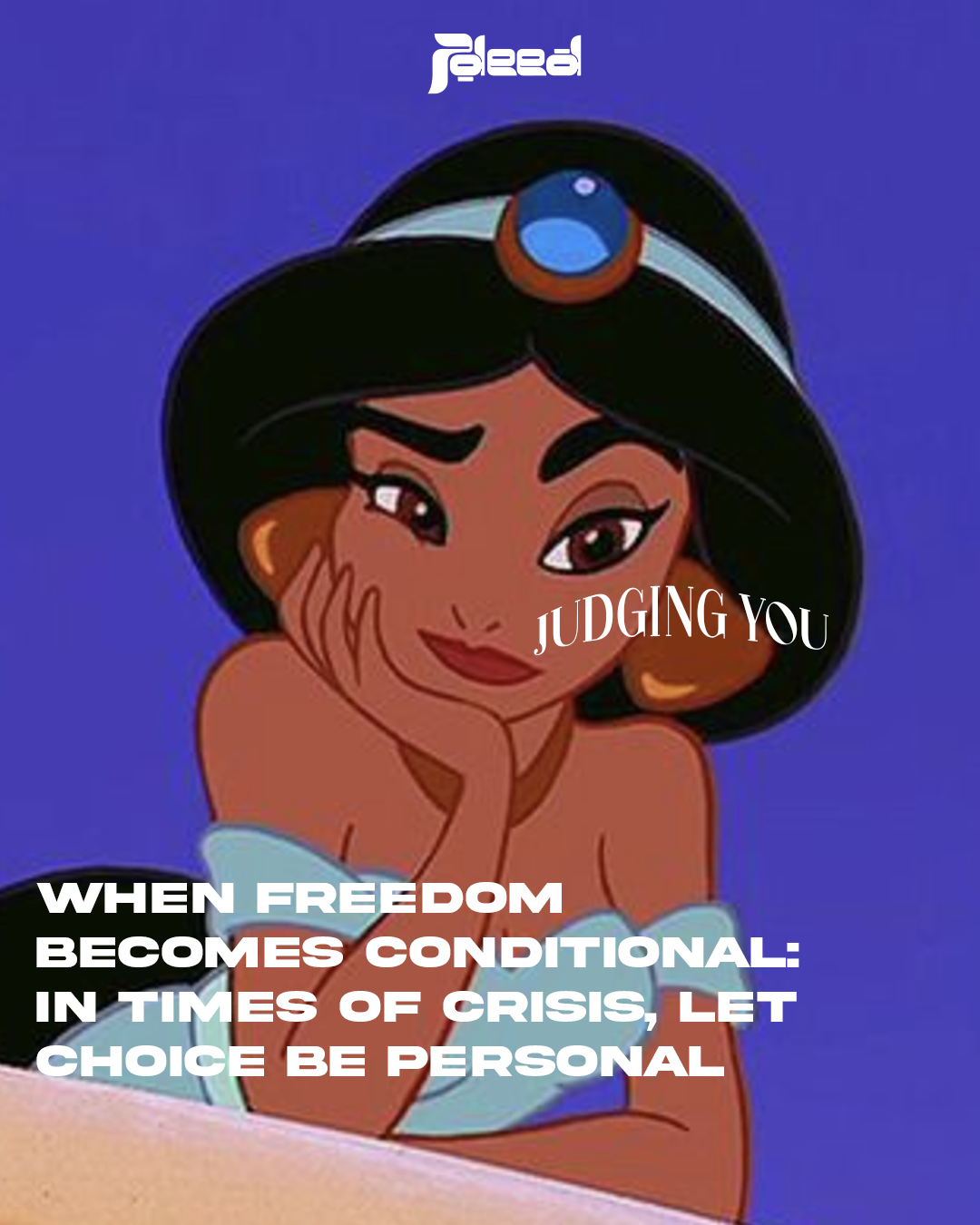
It’s ironic—perhaps even telling—that a generation which prides itself so deeply on the idea of freedom now finds itself increasingly quick to judge how others choose to navigate it.
Since February 28th, as attacks escalated across our region, people have responded in vastly different ways—some choosing to stay, others deciding to leave, sometimes by choice and sometimes out of necessity, some carrying on as if life remained unchanged while others openly acknowledging that nothing feels normal at all, each reaction shaped by personal circumstance, emotional capacity, and an instinct to cope in whatever way feels most bearable.
By Cynthia Jreige

The truth, however, is that every single one of these responses is valid, because we are living through something that is not only unprecedented but deeply disorienting, something that reshapes not just our physical realities but our sense of safety, belonging, and control, leaving each of us to navigate uncertainty without a clear roadmap or shared understanding of what the “right” response might look like.
Leaving, in this context, is not a sign of weakness, nor does it imply abandoning one’s home, one’s identity, or one’s connection to place; rather, it can often be an act of preservation—of mental health, of family stability, of self—just as staying is not a badge of honor or a moral high ground that makes someone inherently stronger, more loyal, or more resilient, but instead a decision that can be equally complex, equally constrained, and equally personal.
And yet, despite this, the question remains: why the judgment?

Across social media, the noise has become impossible to ignore, with statements ranging from “life here is completely normal, I don’t know what people are talking about” to “I chose to leave for a few weeks until things calm down,” each one quickly met with a wave of criticism, as though there were a universally accepted way to exist within instability, as though deviation from that imagined norm somehow warrants explanation or condemnation.
But there isn’t, and there never has been.
What we are witnessing is not simply a difference in choices, but a difference in capacity; an intersection of personal history, emotional threshold, lived experience, and available resources that shapes how each individual processes fear, uncertainty, and disruption, meaning that what feels manageable to one person may feel overwhelming to another, and both realities can coexist without invalidating each other.
Some people have lived through repeated cycles of instability and have learned, consciously or not, to compartmentalize, to normalize, to continue, while others are encountering this intensity for the first time and are still learning how to process it, how to name it, how to carry it; some have the privilege to leave and choose distance as a way to breathe, while others do not, and instead must find ways to create stability within instability, holding on to routine as a form of grounding.
None of these responses are wrong, and yet the danger lies in the assumption that our own way of coping is the correct one; that our choices are more rational, more grounded, more legitimate than someone else’s, because it is precisely this assumption that creates distance where we need closeness, and division where we need understanding.
At its core, this moment is about humanity under pressure, and under pressure, people reveal different versions of themselves: some becoming quieter, others louder, some retreating inward while others reach outward, some choosing distance in order to protect their sense of self while others choose presence in order to feel anchored to something real.
These are not contradictions; they are expressions of survival.
Perhaps the discomfort we feel is not rooted in the fact that people are making different choices, but in the reality that we are being forced to confront perspectives that challenge our own, revealing just how deeply we rely on the illusion that there is a “right” way to endure.
We like the idea of freedom in theory: freedom of movement, freedom of expression, freedom of choice; but freedom, in its truest form, requires us to extend that same permission to others, even when their choices differ from our own, even when we do not fully understand them, even when they make us uncomfortable.

It requires restraint, empathy, and a certain humility; the ability to accept that we do not know what is best for someone else’s life, that we are not operating from the same realities, and that our perspective, no matter how strongly held, is not universal.
In moments like these, solidarity is not about making the same choices, but about respecting that we won’t, about holding space for someone who chose to leave without questioning their courage, and standing beside someone who chose to stay without romanticizing their resilience, understanding that both decisions can come from a place of care rather than contradiction.
Maybe, instead of asking “why did they do that?” we should begin to ask “what might they be going through?”, shifting the focus from judgment to curiosity, from assumption to understanding.
Because the truth is that we are all, in one way or another, trying to find ground in something that keeps shifting beneath us, each of us reaching for stability in the only ways we know how.
And in times like these, the most radical thing we can do is not to judge, but to soften—to listen more closely, to allow more generously, and to support more intentionally, recognizing that freedom is not proven by how firmly we defend our own choices, but by how gently we hold space for someone else’s.

.jpeg)

.png)