SIKKA Art Fair: A Look-Back At What We Loved
January’s art schedule is always packed, a relentless flow of events and exhibitions and opening nights, but no matter what, there is one thing I would never miss.
When Shindagha’s meandering streets lead me to Sikka, a week-long festival that is the crown jewel of Dubai’s art calendar. The neighborhood’s 16 houses become home to every art discipline imaginable – ceramics, paintings, visual art, installations that inspire and console – spun from a lifetime of experiencing the world, through joy and grief and everything that comes with it.
Music fills the spaces in between, a place to stay and commune with strangers for a while. Across the creek, lies old Dubai and the million stories it holds. Somehow, it has all translated into this sprawling coralstone neighborhood, a showcase of humanity’s devotion to all things lovely, imperfect, and all-encompassing. The festival has a tradition of outdoing itself. This year was no different. JDEED spoke to a select few artists that we simply could not forget.
By Saher Azmi
What we choose to preserve, to carry on, shapes our tomorrows.
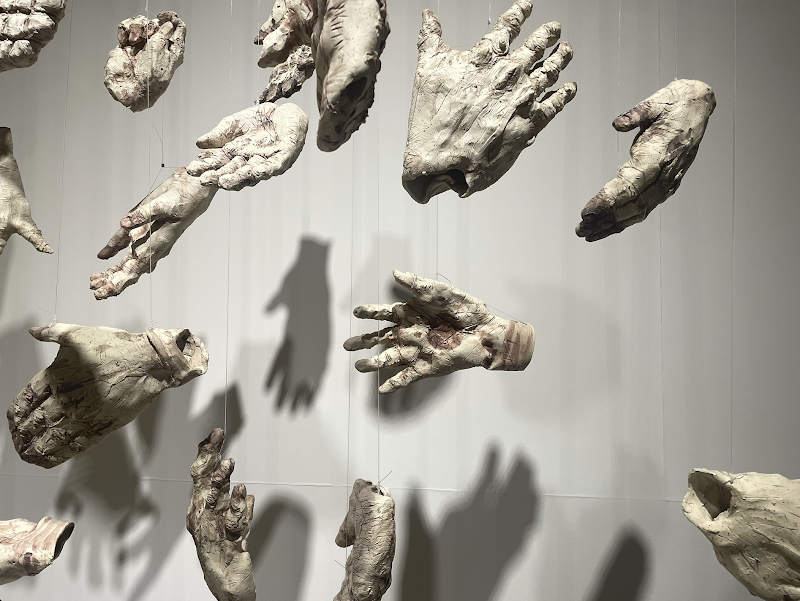
Russian-born artist Margarita Faizulina’s piece, composed of thirty ceramic hands, modeled after the older generation of Emiratis, was a touching tribute to these bearers of traditional crafts, disappearing professions, and manual skills that once shaped everyday life in the past.
“I chose to focus on elderly hands because since childhood I have been fascinated by how much my grandparents knew and could do.” says Faizulina. “Aging hands can sometimes tell more than faces or words.”
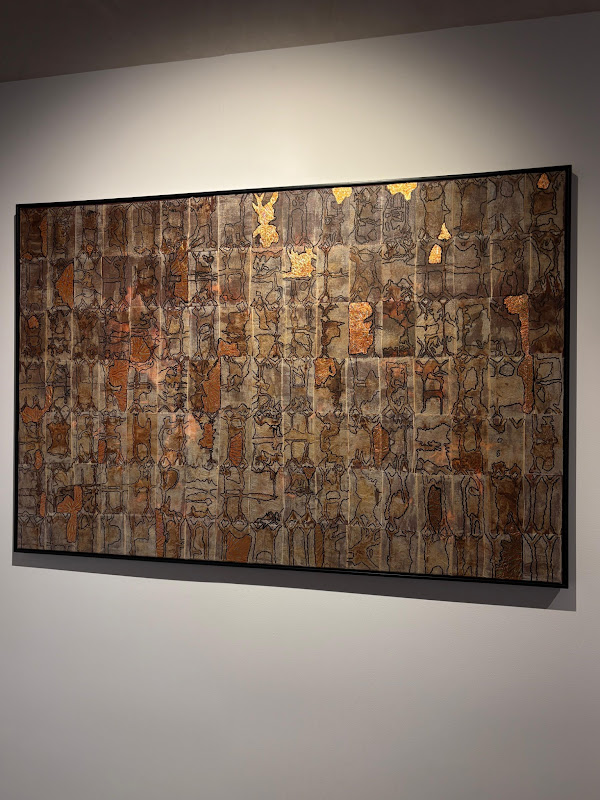
The small details often carry the most meaning. Palestinian-Polish designer and visual artist Neveen Abu Samra echoed this belief in her work, presented at the Visual Art House. She transformed the intimacy of a shared ritual that exists across hundreds of cultures into a tangible art work through used tea bags.
“By collecting, drying and layering these tea bags, I transform an overlooked and temporary material into a lasting visual surface.” Samra explains, “Through this material, I explored how small, ordinary actions can hold emotional value and how memory can be built through repetition and time. The layered surfaces reflect identity as something fragile and constantly forming, shaped by lived experience”
The International House made its debut at Sikka this year, with the theme “Worship of the Imperfect”. Through a series of abstract installations that focused more on feeling than seeing, the International House revealed itself to be one of the most interesting experiences to be had at the festival this time around.
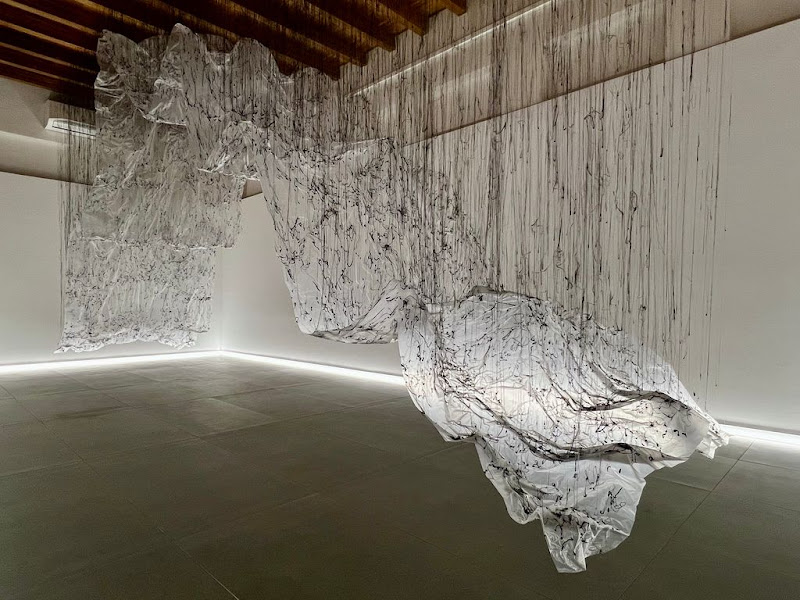
JDEED spoke to Yasuaki Onishi, an exhibiting artist from Japan who specializes in sculpture, and presented his work ‘reverse of volume’ at the festival.
“I reconstruct cavities, empty spaces, and void and boundaries that go unnoticed in everyday life. It's about seeing things from a different angle with a new perspective.”
The installation gives an impression of a mountain except a switch was flipped and we only see its inverse. Only the negative space of it. Constructed of polyethylene sheets, copper foil, and other such materials that easily lose their shape, the mountain floated delicately, its terrain taking up all the space in the room.
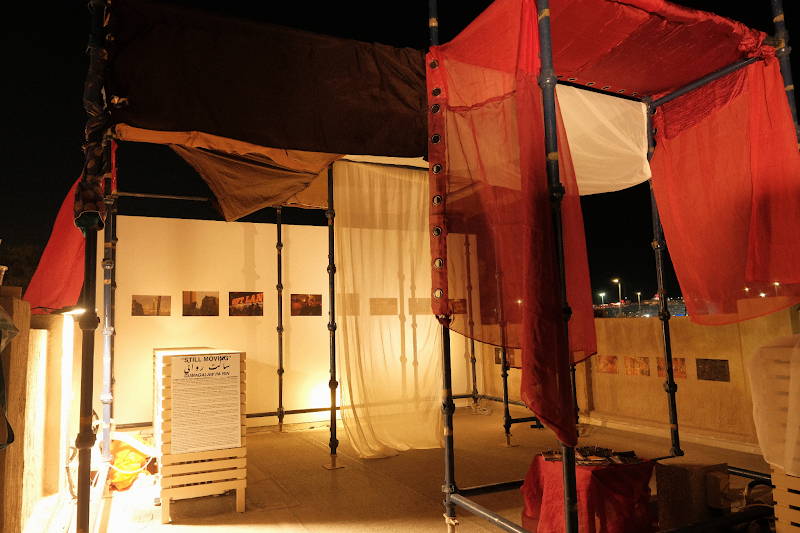
Deira raised Jonathan Edora Sarmiento, who grew up to practice architecture and moonlight as a photographer when he gets time away from “the studio”, as he has a habit of saying.
In ‘Still Moving’, Sarmiento excavates his father’s archive of images, shot on a 2008 JVC camcorder – beginning with his life in the Philippines and continuing as he made the journey to Dubai – and expands it into a wider study of time, memory, and migration.
“The rooftop intervention is a nod to the visual language of Deira.” says the artist, referring to the use of construction materials in the installation; the metal scaffolding, the drifting curtains, backlit softly with warm light and clearly unfinished.
It is the image, the architecture, of a city that is never at rest, never completed. Always moving, always in a transient state, making do much like the people who built it.
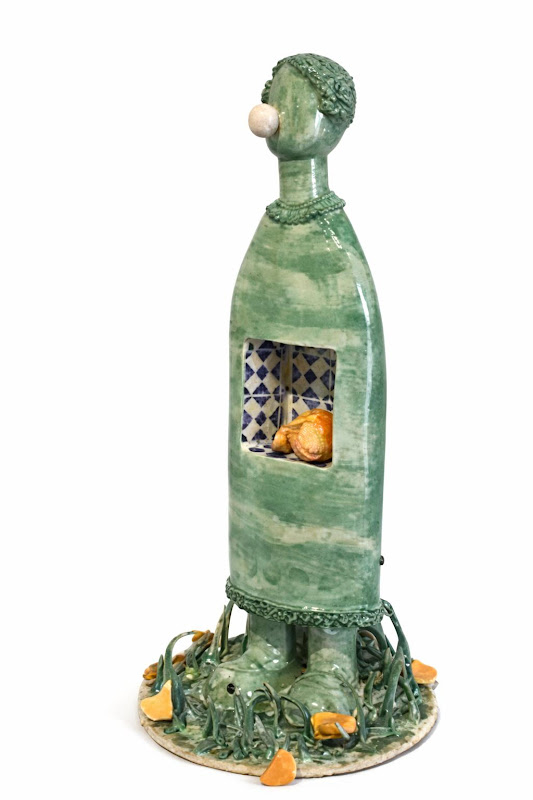
“Clay is where I let myself be slow, whimsical, and a little poetic” says Buata, “I’m interested in how objects can hold stories - not loudly, but gently.”
Yada is what the Moroccan artist named her 3-piece series for the Ceramics House. Each figure seems to have originated from the same whimsical fairyland with little differences setting them apart, all inspiring undulating joy.
One represents the oldest daughter of a family - she’s serious, taller, and has a dignified air, but her inner world suggests someone who has learnt to be happy despite. The other has a soft, kind air to her, the kind of girl you would find picking blades of grass and befriending ladybugs. The last Yada has skin the color of jade. Set into her center is a space wallpapered with Zellige, the traditional Moroccan tile pattern, and sitting within it is a half-peeled clementine. She is the most beautiful.
Buata sees Yada as belonging to the liminal space between cultures and definitions. “She belongs to the in-between, and in that sense, she becomes a soft reflection of Dubai’s future identity: layered, multilingual, imperfect, and deeply human.”
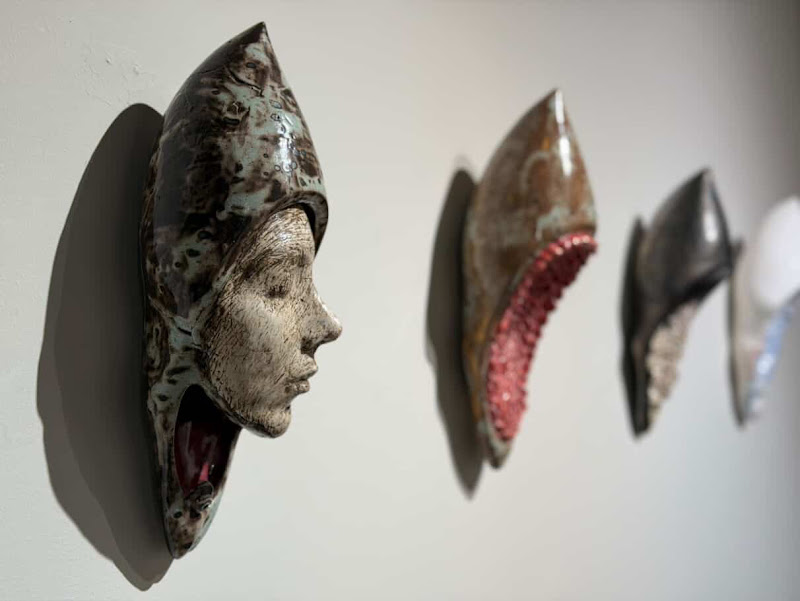
Gazing at Shadi Ziaei’s 4-part ceramic series feels like looking at the many faces of an elemental deity as she molds herself from sea to human.
Ziaei comes from a decade-long background in sculpture. Working with these forms that are fragile yet transformative, she draws from her inner space as she moves between disciplines, reaching a place where strange dreams, buried emotions, and inherited histories turn into a tangible language.
“For me, the future of art in this city is inseparable from the sea.” says Ziaei. “I draw constant inspiration from the sea and see myself as part of it—not just as a source of imagery, but as a way of understanding time, movement, and coexistence. In the same way, I see Dubai as a city deeply connected to the sea, both historically and emotionally.”
Ziaei imagines the future of Dubai as an artistic language that flows the same as the sea – open, fluid, and responsive. She speaks to her sense of responsibility as an artist, of the need to be honest, attentive, and rigorous. A future we all must play a part in, each one a wave in the sea.

.png)