Our Chat With Werner Bronkhorst On His Dubai Exhibition, Emotions And Inspiration
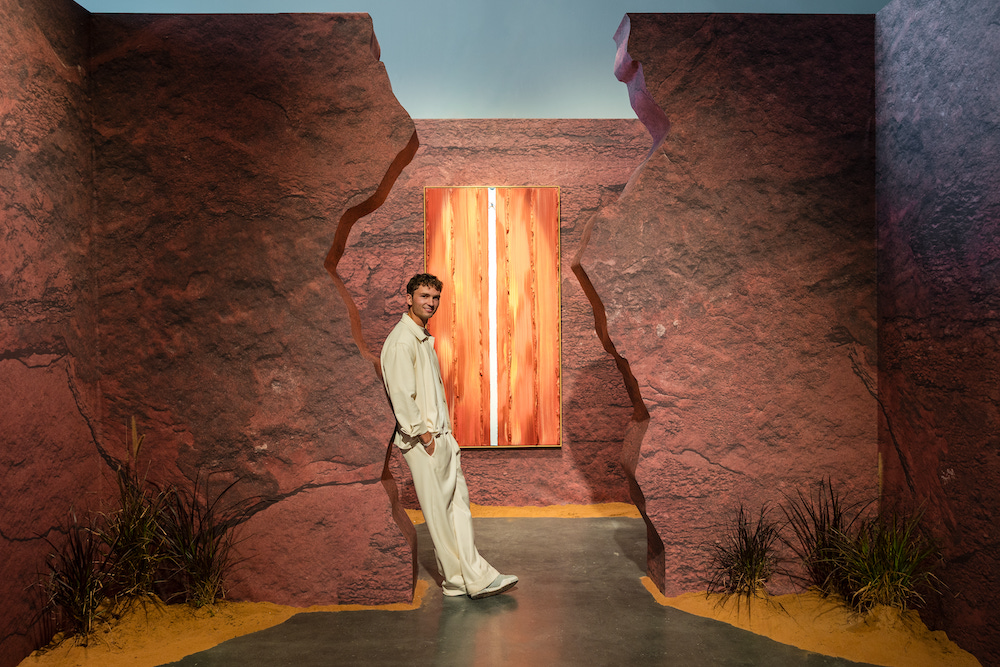
Werner Bronkhorst’s ‘CRACK’ exhibition landed in Dubai for its debut show from 16-18 January. 'CRACK' was the Sydney-based artist’s most ambitious project yet, which unfolded across four atmospheric rooms at Concrete, Alserkal Avenue. Crack – the sound, the tension, the beginning, perhaps the end – was the focal point of artworks on display.
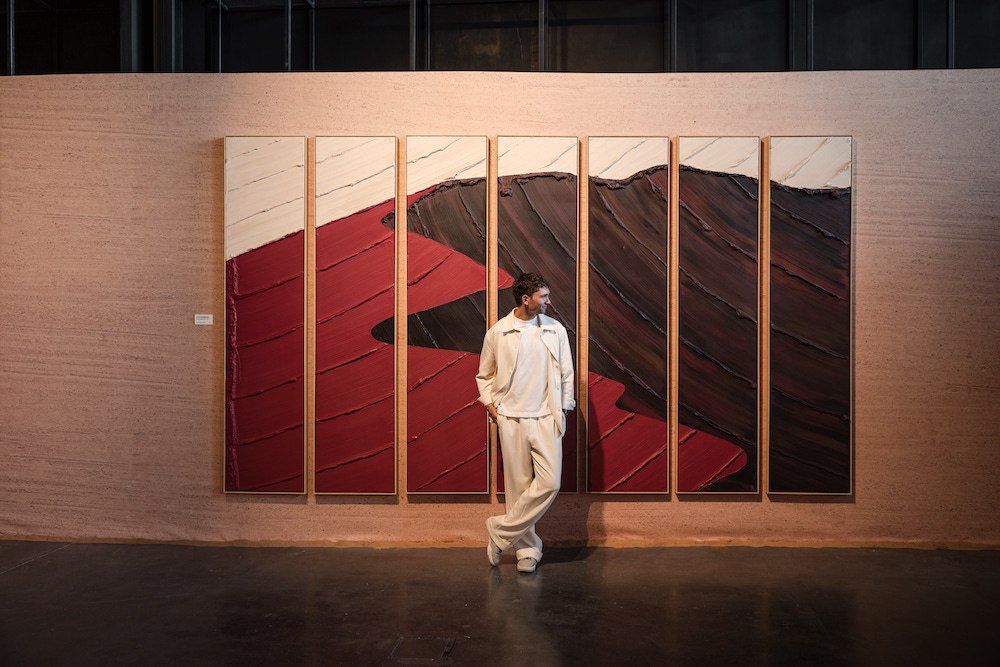
I walked through the rooms – first, I saw salt lakes and beaches, and I thought of days spent at the beach as a child, hot sand crackling under my feet. I moved to the second room and was awestruck by a massive 7-panel painting of a desert, characterized by opulent red and deep brown, and a tiny family trekking across this mammoth expanse, and I thought of those joint family expeditions from my owl life where the unspoken tension of undertaking this long passage would weigh on us all. A dimly lit corridor led to the third room, which felt like stepping into the mouth of a cave behind a waterfall.
Themes of dressage, drawn from Bronkhorst’s family history of the sport, boxing, rock climbing, basketball and Porsches emerged from the walls, illuminated by overhead lights that made the tiny figures within jump out, almost alive. The fourth room was dressed in light once again. More sports motifs, some playful, some contemplative, all echoing the same emotion – crack.
By Saher Azmi
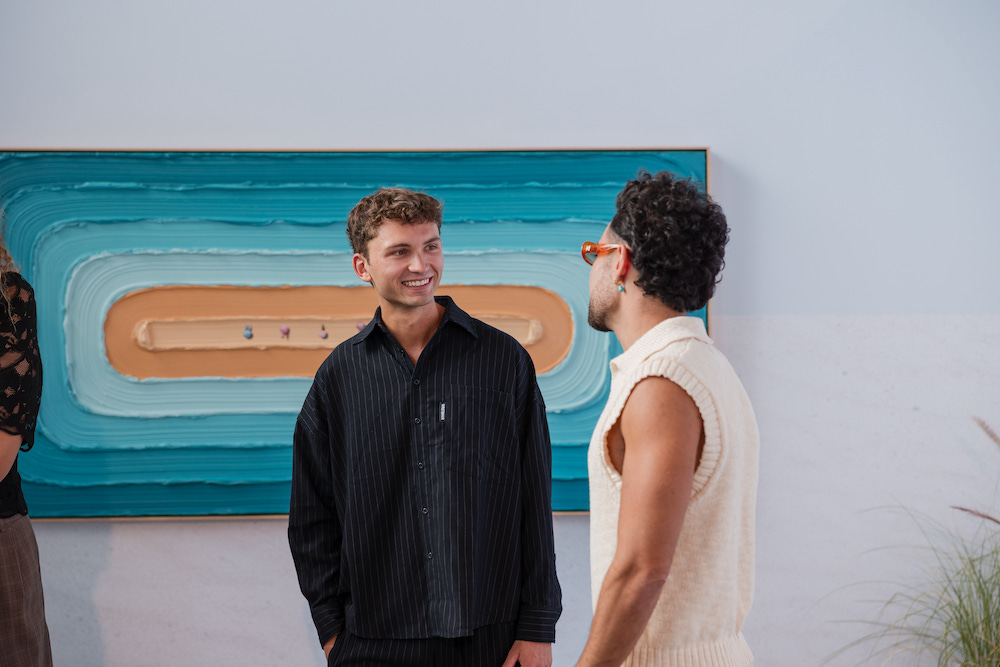
Post-‘Crack’, I had questions for Bronkhorst, curious to know more about the intricacies and inspirations behind the exhibitions. Some of those are graciously answered by him below:
Can you tell us a little bit more about the spiritual side of your art? You mentioned Paulo Coelho's books were an inspiration for ‘The Pilgrimage’ and, of course, ‘The Alchemist’. What did you take away from these books and can we see a glimpse of it in this collection?
Werner Bronkhorst (WB): Spirituality has always played a big role in my life in general but this time I wanted to connect that to my art after reading the books ‘The Alchemist’ and ‘The Pilgrimage’ by Paulo Coelho.
I actually named two artworks after those books to further emphasise its impact on my life and to visualise the storyline in some way. The artwork ‘The Alchemist’ is a relatively small book which revolves around the journey of a young man following his dreams and in the book he journeys through the desert to find the treasure that was revealed in his dream. As such the artwork is also rather small in size and features a camel and a young man walking on what seems to be an abstracted version of a sand dune. This artwork was the study for the much larger artwork ‘The Pilgrimage’ which also features a camel and a young man but with the addition of a wife and two kids. This nuclear family is travelling through a much larger desert landscape on their own journey to seek a new and better future or perhaps simply to travel together. In some ways it resembles my life with my own partner and kids but in many ways there’s a universal understanding that the right decision to move on to a better future can sometimes mean moving through unforgiving landscapes or perhaps going on a spiritual journey which can often feel treacherous or harsh but is more than worth it once the destination is reached and the pilgrimage has ended.
Your paintings feel whimsical and energetic. They draw from a wide array of real life inspirations - tennis, the beach, road trips with your family - but I found myself wondering where is the darkness? Are there any of your artworks that explore darker themes, maybe as an excision of negative emotions?
WB: My artworks tend to stray from darker moments to focus on the light. As such I tend to create artworks that make the viewer feel calm, uplifted and perhaps nostalgic. I do this not only because that’s what makes me the happiest in my craft but also because I’ve been fortunate not to have much darkness in my own life. My goal is to reflect the beauty of the world around us and to show an alternate version of reality- a dreamlike vision where life is balanced and beautiful.
Why did you choose Dubai for ‘Crack’? What drew you to the city?
WB: Dubai is a city that is full of beauty and perfection everywhere you look. A city filled with people from all over the world who are forward thinkers and appreciate art and culture. It also happens to be surrounded by the desert so when I first thought of working on a desert-themed collection of artworks, I knew immediately that the Middle East would be the perfect place to exhibit and no other city interested me as much as Dubai.
In an interview online, you spoke about how your art style will continue evolving as your children grow older, as you have new experiences with them. I thought that was a lovely sentiment, and wanted to know if you’re already seeing a difference, or an evolution, in any aspect of your work as an artist because of the time you spend with your family?
WB: There’s no doubt that my kids have inspired me over the past few years to try new things and explore new territories. Kids look at life with awe and wonder and adults tend to forget how to do that. Being around my kids and having them in the studio with me allows me to dance more, laugh more and live more and that in turn has made me realise that my practice as an artist should be no different. Now I tend to have more fun with artworks. I play around with new concepts, new compositions and more importantly new colours. I include more activities that I may not have experienced yet myself and in turn this has opened my eyes and my frame of reference to the big world all around me, experiencing everything exactly like my children do- with a sense of wonder!

Can you sum up ‘Crack’ in 3 words (and you can’t say ‘Crack’)?
WB: Warm, minimal, nostalgic
Can we get your top 3 (current) music recommendations - perhaps whatever you were listening to as you worked on this exhibition?
WB: I create a playlist for each collection of artworks which follows the theme of the body of work. As such this ‘CRACK’ playlist features earthy sounds and moods that transport you to the desert in some way.
'Savanne' by Vieux Farka Touré & Khruangbin is perhaps my favourite. I actually even have played it on repeat before interviews to help bring calmness
‘Tomorrow’s Dust’ by Tame Impala is a perfect example of calm sounds and good stories. The album cover also features an abandoned house in the Namibian desert where I spent a lot of my childhood.
‘A Horse With No Name’ by America is also just a classic that worked so well for a collection where I painted so many horses!
What’s your absolute favourite piece from ‘Crack’ and why?
WB: My personal favourite is a bit tricky to decide on, given it’s like choosing your favourite child!
But the most important piece in this collection would be ‘The Pilgrimage’ because of all the different ways it connected with me and my story. I’m a young father moving through this big abstract canvas of life with my two kids and wife. It was also the most technical and complex artwork to make- oh and my biggest yet too! This made the challenge all the more difficult but one that worked so well!
More on www.wernerbronkhorst.com

.png)