Elusive Territories: 15 Palestinian Artists Navigate Memory, Exile, and the Meaning of Home in Dubai

There’s something about Elusive Territories that doesn’t sit comfortably, and that’s exactly the point.
Opening at Zawyeh Gallery in Alserkal, the exhibition brings together fifteen Palestinian artists, but it doesn’t feel like a group show in the traditional sense. It feels more like fragments of something larger, scattered, unfinished, still searching. Not for answers, but for a way to hold onto something that keeps slipping.


What you notice first isn’t a single narrative, but a repetition of feeling. Memory shows up everywhere, not as nostalgia, but as something heavier, something that lingers. In some works, it’s soft and almost comforting, like Samia Halaby’s landscapes that carry the quiet of a sunset you can almost step into. In others, it’s dense and suffocating, like Bashir Makhoul’s layered compositions that feel like cities built on top of themselves, holding more than they can carry.
And then there’s the absence. Not loud, not declared, but present in the way space is treated. Mohammed Joha’s work, for example, doesn’t just depict displacement, it feels constructed from it. The materials, the layering, the fragility of it all, it mirrors a kind of architecture that was never meant to last but somehow does.
What’s interesting is how often abstraction becomes the language here. Not as a stylistic choice, but almost as necessity. When something can’t be fully said, it gets broken down into color, into texture, into rhythm. Kamal Boullata turns memory into geometry, into something you can almost read like music. Sliman Mansour strips language down to a single letter and lets it exist as form, not just meaning.
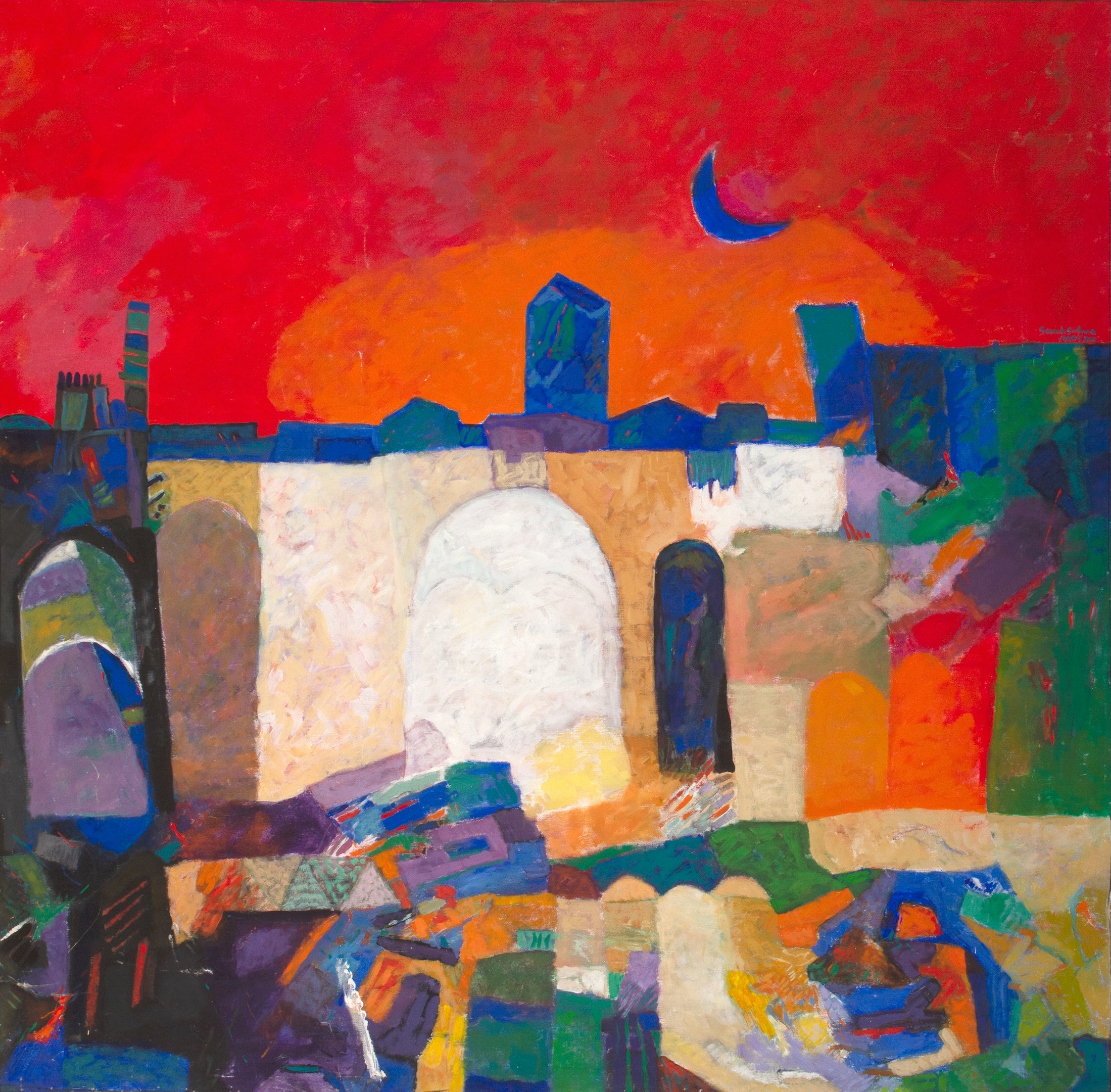

There are moments of softness too. Nabil Anani’s landscapes feel almost utopian, like a version of Palestine that exists somewhere between memory and hope. Trees grow freely, colors feel generous, and for a second, you’re allowed to imagine what it would look like if things were simply… normal.
But the exhibition never lets you stay there for too long.
Because just as quickly, it shifts. Into disorientation, into fragmentation, into the quiet reality that runs underneath all of it. Benji Boyadgian’s work, for instance, plays with perception in a way that makes you question what you’re looking at, while Yazan Abu Salameh brings in materials like concrete and everyday objects, grounding everything back into a reality that is far from abstract.
What ties it all together is this constant tension between holding on and letting go. Between imagining a future and being pulled back into a present that doesn’t quite allow it. And maybe that’s what makes Elusive Territories feel so relevant right now.
Because beyond the context of Palestine, the exhibition taps into something broader, something a lot of people in the region are quietly navigating: The idea of home not as a fixed place, but as something carried, reassembled, and sometimes reimagined just to make sense of things.
It’s not an easy exhibition, and it’s not meant to be, but it stays with you, in that quiet, unresolved way.
ZAWYEH GALLERY
Alserkal
opens April 4th



.png)