Prada FW26: The Art of Becoming
.jpg)
At Prada, clothes are rarely just clothes. They are conversations, contradictions, memories layered into fabric.
And for Fall/Winter 2026, Miuccia Prada and Raf Simons lean fully into that idea, presenting a collection that feels less like a static wardrobe and more like a living portrait of modern womanhood.
Unveiled in Milan inside the Deposito of Fondazione Prada, the show explored the idea that identity is never singular. It shifts, evolves, fractures, reforms. The designers described the collection as “an embrace of inherent pluralities”, reflecting the multifaceted realities women inhabit every day.
Bc Cynthia Jreige
A Wardrobe in Motion


At the heart of the collection was layering, but not the predictable kind. Instead, Prada approached it as a metaphor for time, memory, and transformation. Garments seemed to reveal hidden histories as they moved. Tailoring collided with sportswear. Embroidered satin dresses were layered beneath coats or partially concealed under minimalist silhouettes. The result felt both spontaneous and precise; a wardrobe constantly shifting through the day.
Within each look, as Prada described, “we discover multitudes.”
The layering wasn’t just visual. It suggested the lived reality of clothing: pieces added, removed, repurposed across the rhythms of daily life. A coat over a dress. A skirt over trousers. Fabrics folding into one another like overlapping narratives.
The Beauty of Imperfection

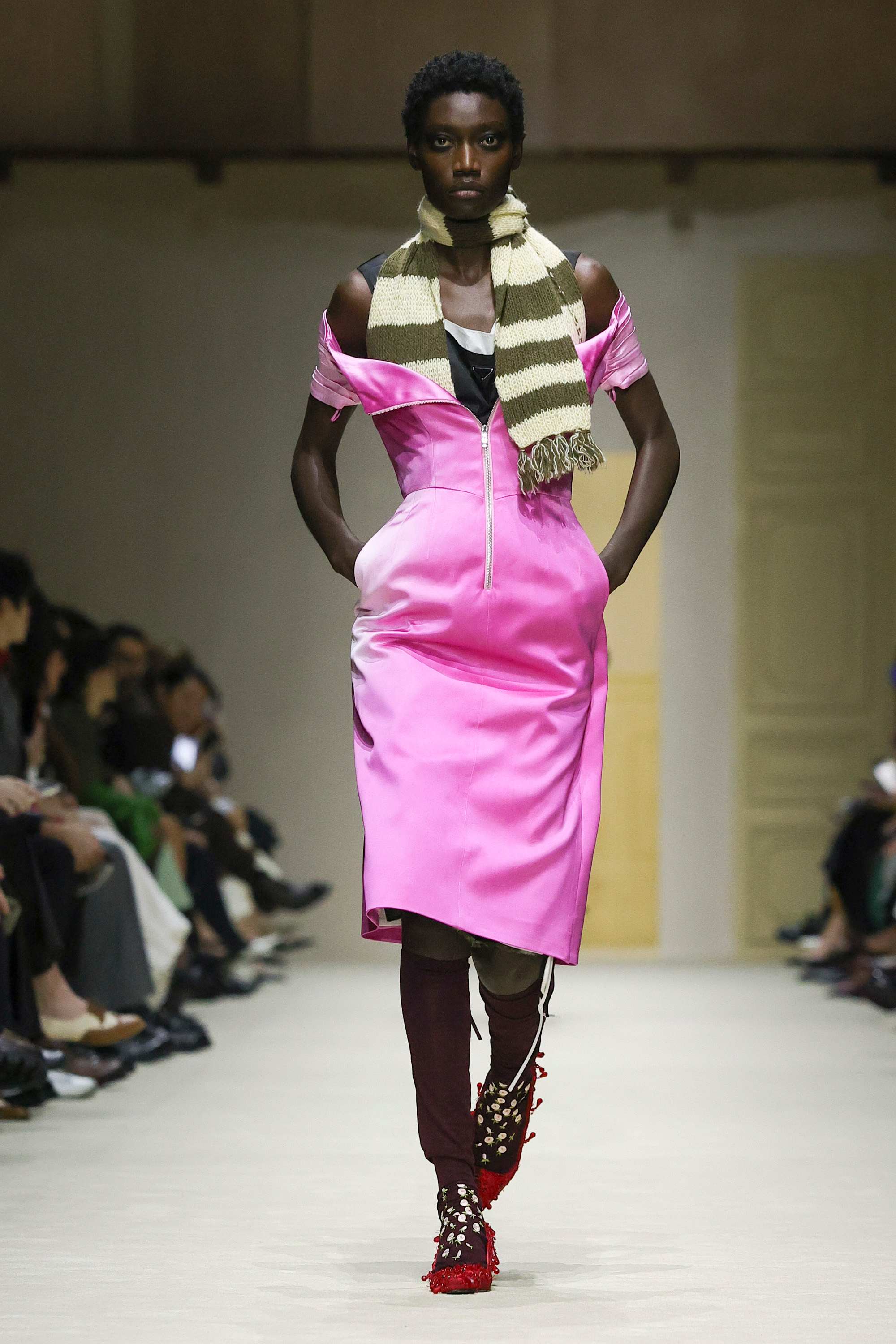
Perhaps the most striking aspect of the collection was its treatment of materials. Rather than pristine surfaces, many pieces appeared intentionally weathered, fabrics faded, embroideries aged, textures distressed.
It created a sense that these garments had already lived a life.
Precious decoration looked patinated, archival dresses seemed embedded within other garments, and materials were sometimes “eaten away as a means of revelation,” exposing layers beneath.
It felt emotional rather than nostalgic. Clothes not as pristine objects, but as companions shaped by experience.
Fifteen Women, Infinite Characters


The runway cast -a defined group of 15 women- reinforced the narrative of plurality. Rather than presenting a single archetype, the show explored how the same wardrobe could hold countless personalities.
Through subtle shifts in styling, posture, and layering, each model embodied a different version of the Prada woman. Strong yet fluid. Intellectual yet instinctive. Familiar yet constantly evolving.
It suggested something quietly radical: identity is not fixed, and neither is fashion.
A Dialogue With Time
.jpg)
Even the setting mirrored the collection’s philosophy. The Deposito of Fondazione Prada was filled with artworks, furniture, and objects spanning five centuries, from Renaissance tapestries and Venetian mirrors to modern chairs and lamps.
These artefacts, each carrying their own histories, echoed the collection’s layered narrative. Just like the clothes, their meanings were personal, shifting, and open to interpretation.
The Prada Paradox
Prada has long thrived on paradox: simplicity revealing complexity, restraint holding emotional depth.
FW26 continues that tradition. On the surface, the silhouettes feel pared back. But look closer and the layers multiply: visually, conceptually, emotionally.
It’s fashion as archaeology and every garment contains another story beneath it. Which perhaps that’s the point.
Because in Prada’s world, identity is never singular; it’s layered, lived, and always becoming.
More on Prada.com

.png)