Mishele Doueihy Is Putting Everything Back on the Table

With Gingham Studies, the Lebanese-Australian artist turns the family table into a space for questions about home, masculinity, sexuality, shame and belonging. Now, after anonymously covering Mexico City with his photographs, Mishele is taking the work off the screen and into physical space.
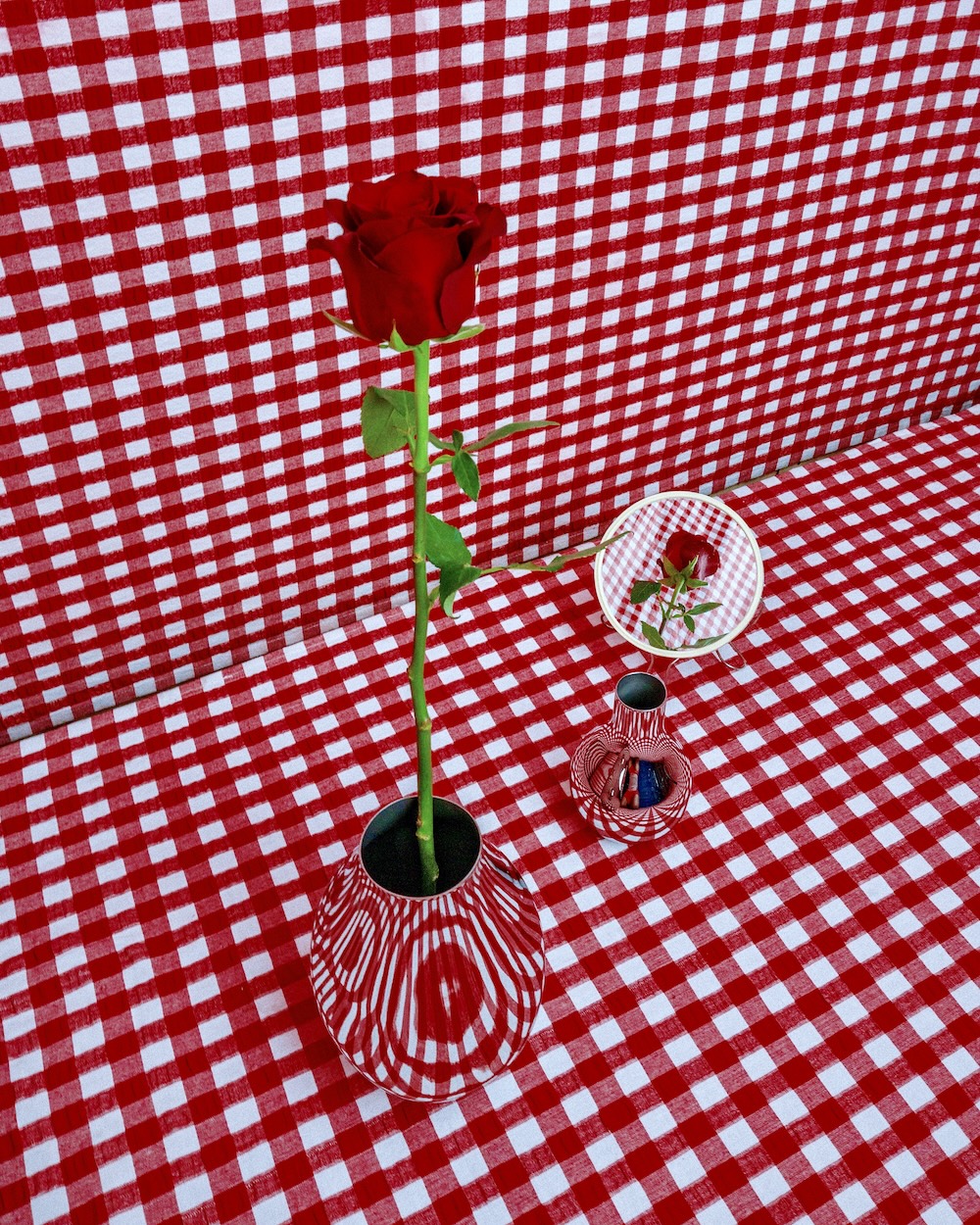
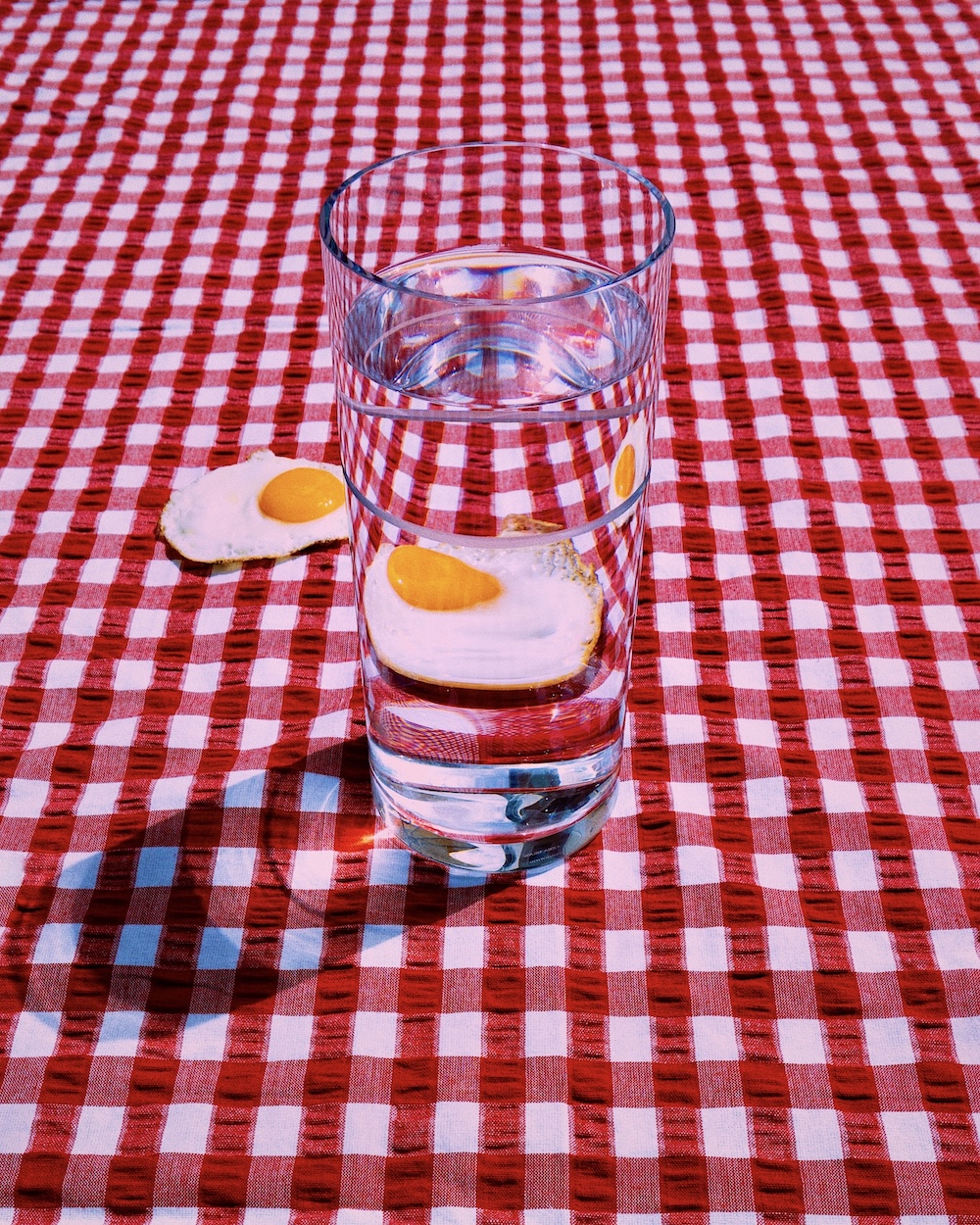
There is a red-and-white gingham tablecloth running through Mishele Doueihy’s Gingham Studies. At first, it feels almost comfortingly familiar. It is the kind of pattern that belongs beneath plates of food, family lunches and the everyday rituals of home. Look a little longer, though, and things start getting stranger.
Made at his parents’ home in Sydney between 2018 and 2019, the five photographs bring together his mother’s cooking, flowers, domestic objects, water, mirrors, a wig and a condom. Humour slips into eroticism, food into sexuality, and the familiarity of the family table becomes a place to examine some much less comfortable questions.
What makes the series particularly interesting today is that Mishele himself no longer sees it in quite the same way he did when he made it: “I understood far less consciously about the work then than I understand today, and I find something beautiful in that,” he tells JDEED.
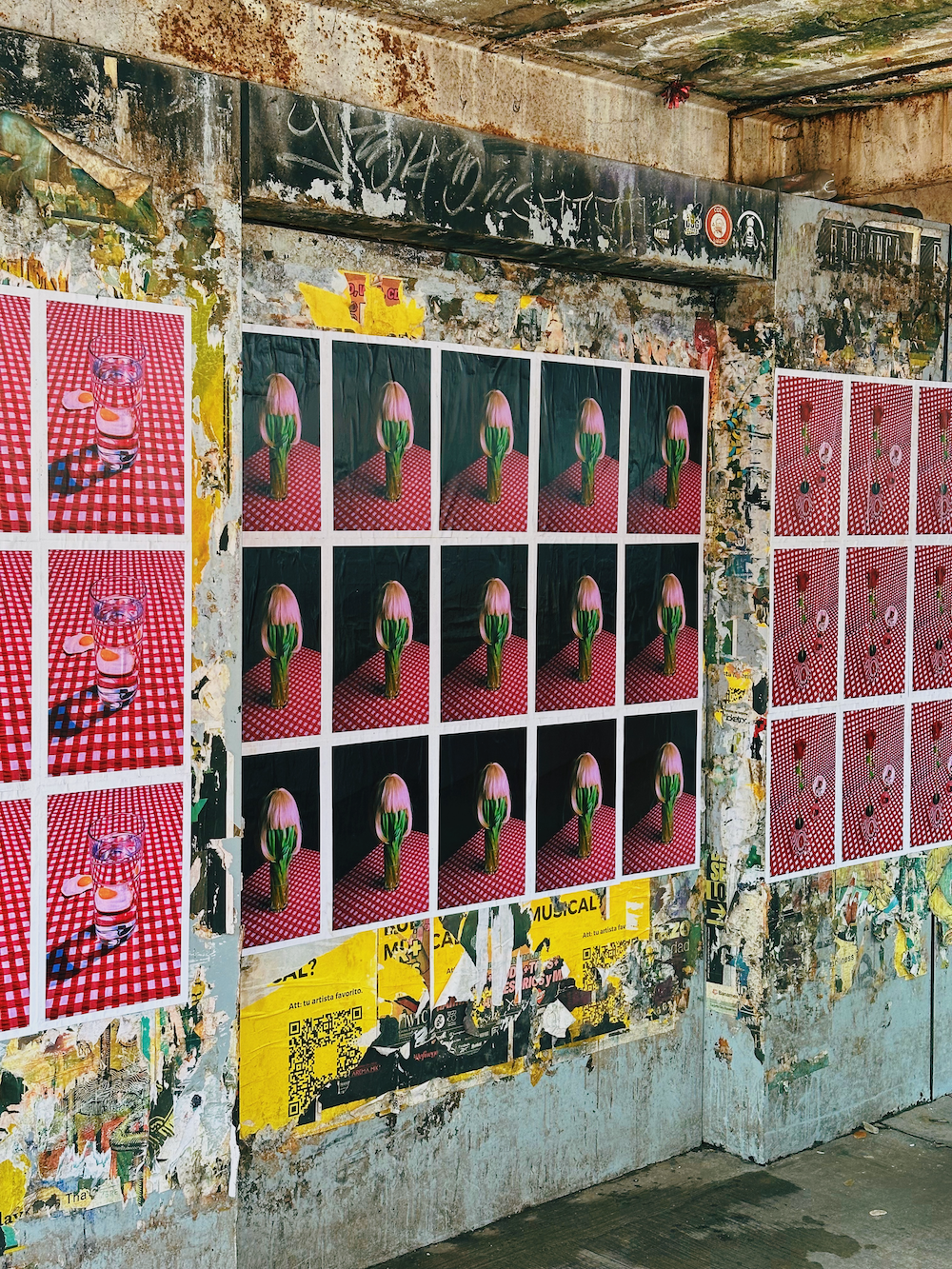
“Sometimes the work seems to know something before the artist consciously knows it.” Seven years later, Gingham Studies has travelled from that family table in Sydney to the streets of Mexico City, where 150 unsigned posters appeared across three public sites in June 2026. It is now moving towards an independently produced spatial solo exhibition planned for Mexico City Art Week in February 2027. Along the way, the work has also become something of a map of Mishele’s own changing understanding of himself.
When Mishele first began working with gingham, his attraction to it was primarily visual. He liked the grid, its graphic quality and what happened when it was distorted through water and reflection.
Only later did he begin to understand why it may have felt so instinctively right. “Gingham has this extraordinary ability to communicate home while moving across cultures
without a fixed geography,” he explains. “You can place that tablecloth in so many different parts of the world and there is immediately something familiar about it: nourishment, care, intimacy, someone preparing something for someone else, the feeling of sitting down and being received.”
For someone raised between Australia and Lebanon, that familiarity without a fixed geography took on another meaning.“For much of my life there has been this deeper question around belonging and where home actually is. For a long time I looked for home through geography, through cities, relationships, spaces and cultures.”
.jpeg)
Looking back, the choice of gingham suddenly made sense. “I had intuitively chosen a visual field that carried the feeling of home while remaining geographically open. The language for that recognition arrived later, but the work was already holding the question.” And wherever the idea of home appears in these photographs, his mother is never very far away; she quite literally made some of what appears in them. The bolognese used in Food Porn was hers. But Mishele now sees her contribution as something much larger than what was placed in front of the camera: “She created the conditions in which I could make the work. She nourished me literally, and she nourished my expression,” he says. “I could be making something completely strange or provocative in my parents’ home and she might laugh or tell me I was crazy, but underneath that there was always a very deep permission to express myself fully.”
Towards the end of her life, his mother also became increasingly insistent on calling him an artist, even when Mishele himself wasn't quite ready to use the word: “I would describe myself through whatever professional role I was occupying at the time and she would correct me: ‘He’s an artist (...) she seemed to recognise something that I took much longer to fully claim for myself.”
Years later, while reprinting Gingham Studies in Mexico City, that memory returned with unexpected force. “I remember holding the prints and suddenly feeling as though I was communicating with the person who had made them years earlier in my parents’ home. I cried,” he says. “There was this strange feeling of looking backwards through the work and thinking: did you have any idea where this would take you?” His mother was there too, despite no longer being physically present: “There was something like a quiet message moving through time: look, Mum, I did it.”
Food isn't the only thing Mishele believes we inherit around a table. “A family table feeds us far more than food,” he says. “It feeds us ideas. It feeds us religion, gender roles, cultural values, definitions of success, definitions of propriety, ideas around the body, desire, right and wrong.”
“We sit at the table and receive all of that, often long before we have the awareness to question what we are ingesting. Then at some point in life, the deeper work becomes deciding what we actually want to digest.”

For Mishele, those questions are inseparable from growing up between Lebanon and Australia and within a Lebanese Christian family. “As a gay Lebanese man raised with Christian values, I inherited particular ideas around what a man should be, how masculinity should look, how sexuality should be expressed, and how desire sits within ideas of family, religion and belonging,” he says. “Much of the deeper work became learning how to distinguish between what felt genuinely mine and what had entered me through the projections and expectations surrounding me.”
The photographs gave him somewhere to work through that tension before he necessarily had the words to articulate it: “I could place a condom there. I could place a synthetic wig over living flowers. I could bend the gingham through water and mirrors. I could replace a meal with an image on a screen (...) there were questions I may have struggled to articulate directly at the family table, but I could ask them through the canvas of the family table, through the still life.”
Food Porn is probably the most provocative example. His mother’s bolognese is placed inside a condom, an image that is funny, uncomfortable and unexpectedly tender depending on how you choose to look at it: “My mother nourished the body through which I came into this life, and desire is part of the life that came through that body,” Mishele says now. “Sexuality belongs to that life. Expression belongs to that life. Nourishment and desire become part of the same living continuum.”
That coexistence is central to Gingham Studies. Mishele doesn't necessarily try to resolve the contradictions. He puts them together and sees what happens.
When Mishele decided to bring Gingham Studies back into the world in 2026, he could have chosen the obvious routes. A gallery. An exhibition announcement. Instagram.
Instead, on June 29, all five photographs appeared as 150 unsigned and untitled posters across three sites in Mexico City. There was no artist's name, no biography, no price, no Instagram handle and no explanation telling passers-by what they were supposed to be looking at.
“For me, the deeper why was questioning access,” he explains. “I was questioning who gets access, how access is created, and why there is such a defined pathway through which art is expected to enter the world: gallery, institution, representation, permission.”
There was also a much more personal question underneath it: “How long was I going to wait for an external structure to confirm something I was finally recognising within myself?”
Mexico City proved particularly important to that process. Mishele describes being struck by the amount of creativity that simply exists in public there: music, graffiti, food stalls, colour, posters, craft and improvisation.
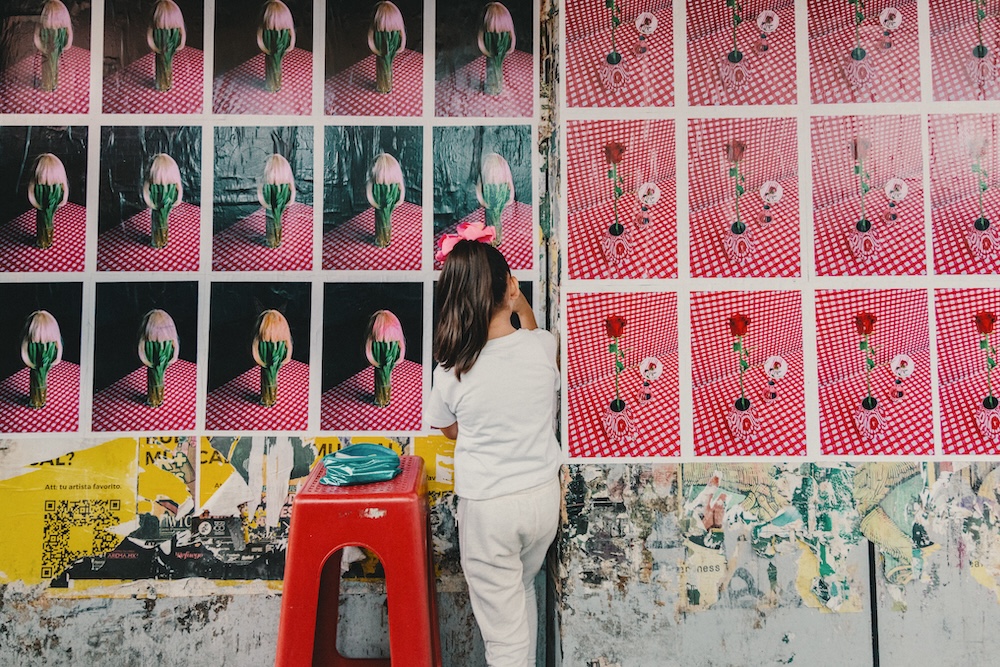
“My mother had spent years telling me, ‘You are an artist,’ and Mexico City seemed to echo that permission in another language: then express.” So he did. The anonymity was intentional: “I deliberately removed my name, the titles, the price, the explanation, the website and the Instagram handle because I wanted the image to arrive before the information surrounding it,” he says. “I became curious about another condition: what happens when the person meets the work first?”
Instead of turning the posters into advertisements for Mishele, he wanted the encounter to belong to whoever happened to walk past: “They could love the work, dislike it, laugh, feel disturbed, become curious, or carry an impression of it somewhere within themselves without ever consciously resolving why.”
Or, as he puts it more simply: “Instead of leading the person towards me, I wanted the work to lead them towards themselves.” Then things got complicated.
During the intervention, Mishele’s collaborator José was arrested. Police later removed the posters, and the pair received the highest fine available under the vandalism classification. Suddenly, a conceptual exercise about permission had become very literal. “If an image is placed on a wall as an act of expression, at what point does it become vandalism? Who determines that distinction?” Mishele asks.
“Why can one image occupy enormous amounts of public space because permission has been purchased, while another image enters a completely different category because it has moved through a different relationship to authority?” Rather than seeing the arrest as something separate from the artwork, he now considers the city's response another chapter in it: “the intervention entered the city carrying one set of intentions, and the city responded with something I could never have scripted. That response enlarged the work (...) the artist initiates something, and then the world becomes a participant.”
There is another form of access Mishele has been reconsidering: Instagram. His issue isn't with the platform itself. It is with what constant availability had started to do to his relationship with his own work: “everything was available,” he says. “Someone could scroll through years of what I had created in a matter of minutes, pause on something for a few seconds, perhaps think, ‘that’s beautiful’ or ‘he’s talented,’ and then continue.”
As he returned to his archive, he began seeing connections he hadn't necessarily recognised when he first made the work: “recurring questions around perception, consciousness, home, masculinity, desire, technology and form.” His response was to remove his Instagram feed.
“Removing my Instagram feed felt like taking back my authorship,” he says. “It created space for me to re-enter a relationship with my own work before asking the outside world to have a relationship with it.”“I had reached a point where the recognition happening inside me carried more weight than the continuous reflection of being seen as creative or talented.”
For an artist preparing to make his work considerably more public, withdrawing it from the most obvious public platform might seem contradictory. For Mishele, it was precisely the point. He wanted to reconsider how, where and under what conditions the work should be encountered.
The next chapter of Gingham Studies will expand beyond photography into sculpture and installation Mishele is developing the project into a spatial solo exhibition for Mexico City Art Week, planned for February 3 to 7, 2027, with the gingham grid beginning to leave the photograph and become sculpture and installation.
“The questions inside the photographs have started exceeding the photograph,” he explains. “The gingham was originally the field that held the image together, and now I am interested in what happens when that field itself becomes form.”
Returning to Mexico City feels less like bringing an exhibition to a city than continuing something that began on its streets.
“Returning feels almost like answering a letter,” Mishele says. “The city communicated something to me, and the exhibition becomes my response: this is what I heard, this is what I learnt, this is what changed within me, and this is the form that has emerged through that exchange.”
Perhaps that is the thread running most clearly through Gingham Studies. Mishele made five photographs years ago without fully understanding everything they contained. He returned to them as a different person and found his mother, his Lebanese and Australian identities, sexuality, masculinity, religion, shame, nourishment and questions of home waiting for him inside.
Now he wants to give everyone else enough room to find something of their own there too. “I want someone to enter the work physically, to experience its scale, material, shadow, repetition and atmosphere, and to notice what happens within their own perception before language settles around the experience,” he says.
“The work has continued doing that to me. I want to give it enough space to do that to someone else.”
Follow Mishele's work on Instagram @mishele.doueihy

.png)