Bvlgari Gives Its Most Roman Watch Two Very Different Summer Moods
Is it the ultimate Summer watch? Bvlgari just introduced the Bvlgari Bvlgari, a design that has spent five decades sitting somewhere between Roman jewellery and impeccable Swiss watchmaking.
This season, the Maison is revisiting the icon through two very different ideas of how a warm-weather watch should feel. One is light, technical and unapologetically sporty: the Bvlgari Bvlgari Aluminium, now dressed almost entirely in white, with a second limited edition featuring a vivid blue dial. The other is more precious and distinctly Roman: two 33 mm models with pink or green mother-of-pearl marquetry dials, each assembled from approximately 400 tiny pieces.
Same family, different holiday plans.

The Bvlgari Bvlgari story began in 1975, when Gianni Bulgari created the original Bvlgari Roma as a gift for 100 of the Maison’s most important clients. Gérald Genta reinterpreted the design in 1977, giving rise to the Bvlgari Bvlgari name and the form that would become one of the brand’s clearest watchmaking signatures.
The double engraving around the bezel is often treated as a piece of bold branding, but its origin is more considered than that. The circular inscription refers to ancient Roman coins and the monumental Latin lettering found across classical architecture. It is an idea that feels unmistakably Bvlgari: Roman history turned into something graphic, modern and slightly provocative.
And unlike many logo-heavy designs, it has aged remarkably well.
When Bvlgari introduced the Aluminium in 1998, the decision to combine aluminium with rubber was genuinely disruptive. At the time, luxury sports watches were still largely associated with steel, gold and conventional ideas of permanence. Bvlgari went in the opposite direction, using industrial materials to create something lighter, more informal and more connected to the way people actually dressed.
The engraved rubber bezel, integrated rubber bracelet and aluminium case made it feel almost anti-luxury; except the design was too precise and too recognisable to be anything but luxury. Since 2020, the line has also been powered by an automatic mechanical calibre, giving the material experiment proper Swiss watchmaking substance.
The new summer versions stay very close to that original spirit.
Both arrive in a 40 mm sandblasted aluminium case with a titanium crown and caseback, a white rubber bezel and matching integrated strap. They are water-resistant to 100 metres and powered by the automatic B77 calibre, offering hours, minutes, central seconds, a date display and a 42-hour power reserve.
In other words, these are not simply white summer accessories, they are properly usable watches.

The monochromatic reference is the quieter of the two, although an entirely white Bvlgari Aluminium is hardly anonymous. Its opaline dial is matched with rhodium-plated markers and hands, while the rubber bracelet and bezel keep the entire watch within a controlled white and silver palette.
The effect is cleaner than flashy. White watches can easily drift into novelty territory, but the contrast between rubber, brushed aluminium and titanium gives this one enough texture to avoid looking flat.
It is also the version that best reveals what has always made the Aluminium interesting: the tension between an industrial case, a luxury name and a design that refuses to behave formally.
The Blue One Is the Collector’s Pick

The second version keeps the same white architecture but adds a deep blue sunburst dial, blue indices and hands, and a red-tipped seconds hand.
Only 500 pieces will be produced, which immediately makes it the more collectable reference of the pair. The blue changes the watch more than expected.
Against the white rubber and pale aluminium, the dial becomes the visual centre, shifting in the light while still feeling legible and sporty. The red detail on the seconds hand adds just enough contrast without turning the watch into a flag.
Between the two, the white model is the purist choice. The blue feels more expressive and probably the one enthusiasts will remember from this release.
The two 33 mm Bvlgari Bvlgari models take an entirely different approach. Here, the story is not lightness or technical sport. It is craftsmanship on a scale small enough that you have to look closely to understand what is happening.
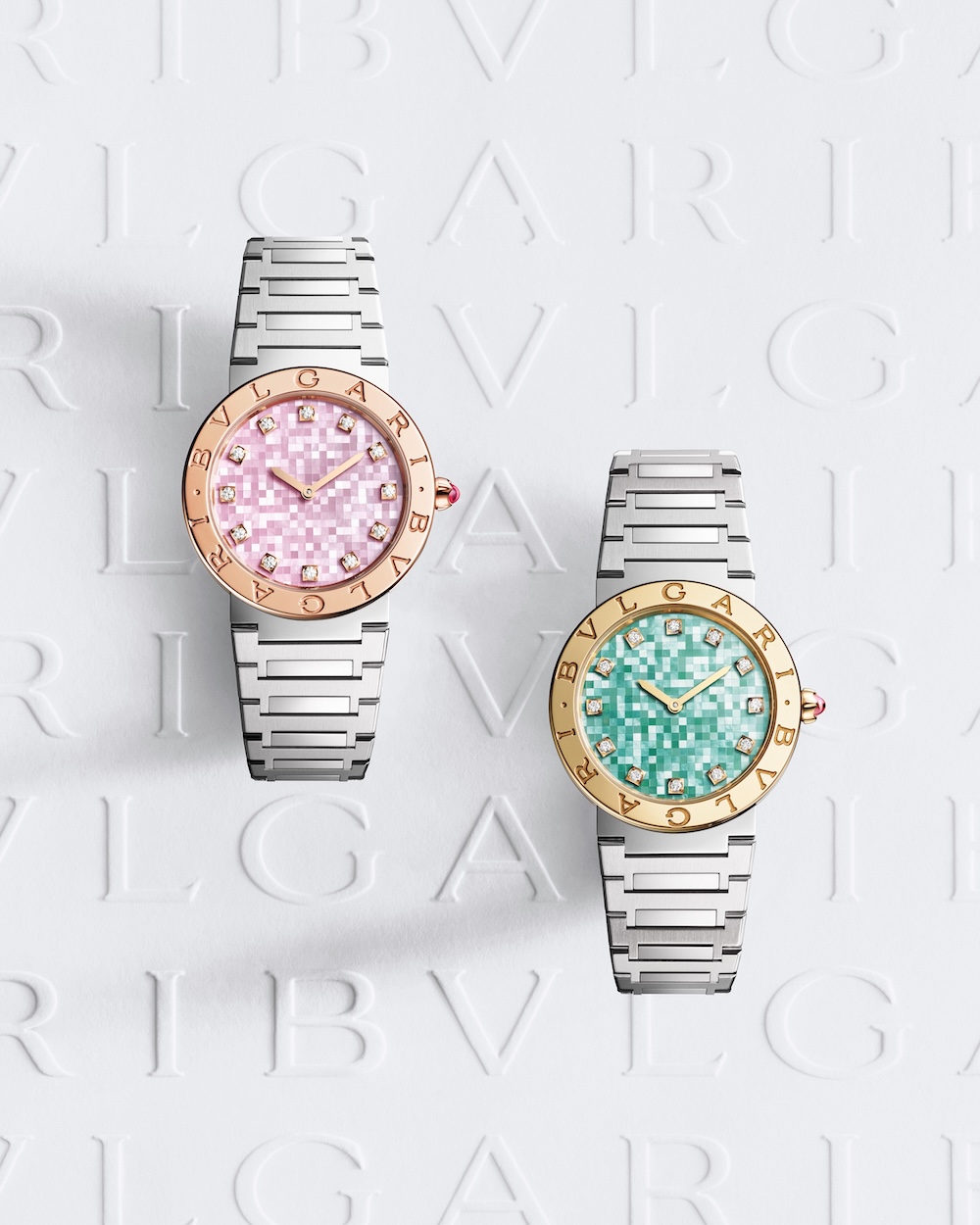
The dials are made using mother-of-pearl marquetry inspired by the Roman tradition of polychrome mosaics. Around 400 tiny fragments are individually arranged to create each dial, producing a surface that changes constantly depending on the angle and light. Twelve diamond hour markers sit across the composition without overpowering it. This is where Bvlgari’s jewellery instincts become particularly useful.
Mother-of-pearl dials are hardly new in watchmaking, but these do not rely on one simple sheet of iridescent material. The fragmented construction gives them more depth and irregularity, closer to a miniature mosaic than a conventional decorative dial.
Pink or Green?
While the pink version pairs its mother-of-pearl dial with a rose-gold bezel, rose-gold hands and a crown set with a pink tourmaline cabochon, the green version uses yellow gold for the bezel and hands, while keeping the same pink tourmaline crown detail. Both are housed in polished steel cases and bracelets, creating a two-tone look that feels jewellery-led without becoming overly ornate.
At 33 mm, the proportions are compact and elegant. Both use quartz movements with hours and minutes only, which may disappoint anyone insisting on mechanical watchmaking at every price point, but the movement is not really the main event here.
These pieces are built around dial craft, colour and the way gold, steel and mother-of-pearl behave together on the wrist. The green model is probably the more distinctive of the two. Its dial moves between mint, turquoise and deeper emerald tones, while the yellow-gold bezel adds warmth. The pink is softer, but not overly sweet. The fragmented marquetry keeps the colour from feeling uniform, and the steel bracelet gives it enough structure to stay modern.
These releases truly demonstrate how much flexibility exists inside one very recognisable design. The Aluminium models strip the watch back to rubber, brushed metal and graphic contrast. The mother-of-pearl pieces move in the opposite direction, bringing ancient decorative techniques, diamonds and precious metals into the same circular architecture.
The logo remains where it has always been, the Roman reference is still clear. The watch is still instantly identifiable across a room.
But depending on the version, it can now look equally at home beside a pool, on a boat, at dinner in Rome or under the kind of lighting that makes mother-of-pearl do all the work for you. Bvlgari may be selling two visions of summer here, but watch people will understand the real problem immediately: choosing just one.
More on Bulgari.com



.png)